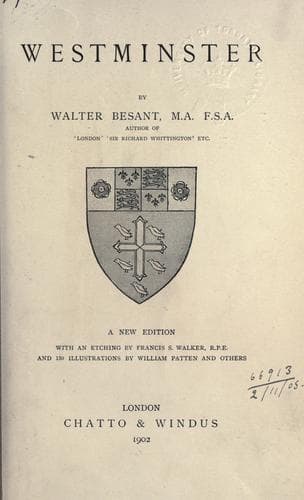
Westminster (London, England) -- Description and travel
The position of governor, or rector, of such a community was, it will be
readily understood, one requiring special, rare, and valuable qualities.
He must be, first of all, a man of courteous and conciliatory manners;
he must know how to be firm and how to assert his rights; he must be
watchful for the extension, and jealous for the observance, of
privileges; he must be ready to seize every opportunity for advancing
the interests of the community; he must not be afraid to stand before
kings; he must be a linguist, and able to speak the language of the
court and the language of the market. When we learn, therefore, that
Caxton was presently raised to the very important office of Governor of
all the English merchants, not only in Bruges, but in other
towns,--Ghent, Antwerp, Damme, Sluys,--we understand from this single
fact the manner of man he was supposed to be; when we learn in addition
that he continued to hold his post till he was forty-five years of age,
we understand what manner of man he must have been.
There is, as one who studies this time cannot fail to remark, a special
kind of dignity belonging to these centuries; it is the dignity that
springs from the knowledge of one’s own rank or place, at a time when
rank, place, or station belonged to every possible occupation of life. A
bricklayer or a carpenter, as well as a mercer, or a monk, or a priest,
belonged to a trade association; he was ’prentice first, full member
next, officer or even warden in due course. The most humble employment
was dignified by the association of its members. Everybody, from the
King to the lowest craftsman, understood the dignity of associated
labor; everybody recognized office and authority, whether it was the
episcopal office or the presidency of a Craft Company. You may see
Caxton in every picture that presents a _bourgeois_ of the time. He
wears a long gown of red cloth, something like a cassock, the sleeves
and neck trimmed with rich fur; round his neck hangs a gold chain; his
belt is of leather, gilt, and from it hangs his purse; his hair is cut
shorter than the nobles wear it, and it is seen under a round cap, the
sides of which are turned up. It is a costume admitting of great
splendor in the way of material; the fur lining or trimming may be broad
and costly; the gold chain may be rich and heavy; the belt may be
embossed by an Italian artist--all the advantages of mediæval costume
are not with the knight and soldier. As for his face, it is grave; his
eyes are serious; it is not for him that the Court Fool plays his
antics; it is not for him that the minstrel strikes his mandolin: he is
thinking what new concessions he can get from the Duke of Burgundy.
Above all, at this moment he is troubled about the late quarrel in
Antwerp between certain English sailors--young hotheads--and some
Flemings, in a tavern, after which two of the latter were found dead.
And the town, without considering who began the brawl, was of course in
Public-domain text, read in full here on John Shaqi.
Reviews
Reviews
No reviews yet
Be the first to share your thoughts on this work.
Elsewhere in the archive
Join the Discussion
Join the discussion
Sign in to leave a comment or review.
Sign InorCreate an account