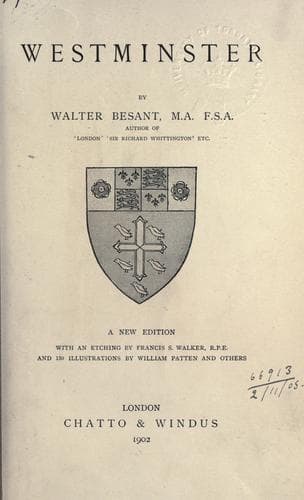
Westminster (London, England) -- Description and travel
Who was the first printer?
You may read all the books, pamphlets, and articles; you may consider
all the arguments, and in the long run you will know no more than you
knew at the beginning. Perhaps it was Coster of Haarlem, or perhaps it
was Gutenberg of Mainz. No one knows, and really it matters little
except for the antiquary and the historian. At this period, as we have
seen, some modification in the old method of copying was certain to be
invented. It was by the greatest good luck, I have always thought, that
a sort of shorthand, a representation of words by little easy symbols,
was not invented. For instance, supposing a separate symbol for each of
the prepositions, articles, and auxiliary verbs, and other separate
symbols for the commoner words, there might be some thousands of symbols
in all to be learned by the scribe; but his labor would be reduced to
one-tenth. They might have invented some such method. Then, satisfied
with the result, we should have gone on for centuries, and the art of
printing would still have to be invented.
But the time was come, and the invention, happily, came with it. Had
printing been invented two centuries before, it would have been
neglected and speedily forgotten, because there was no demand for books.
Had it been invented two centuries later, it would have had to contend
against some other contrivance for shortening labor and cheapening
books. If an ingenious projector discovers some great truth or invents
some useful contrivance before or after his time, he is lost--he and his
discovery. Thus, in the reign of James the First a man of great
ingenuity contrived a submarine boat--he was before his age. In the
middle of the last century another ingenious person discovered a way of
sending messages by electricity--he was before his age. In a romance,
now a hundred and fifty years old, the possibility of photography was
imagined by another person before his age. Men whose ideas are much
before their age receive, as their reward, contempt, certainly;
imprisonment, probably; and perhaps death in one of its more unpleasant
forms.
The generally received story, after all that has been said, is this:
There was a certain Johann Gensfleisch von Sorgenloch, called Zum
Gutenberg, a man of noble family, who was born in Mainz somewhere about
the end of the fourteenth century. He removed from his native town to
Strasbourg, where he began experimenting upon wood blocks. He then, with
the idea of printing clearly defined in his mind, perhaps with type
already cut in wood, went back to Mainz and entered into partnership
with three others, named Riffe, Heitman, and Dritzchen. Documents still
exist which prove this partnership, and contemporary evidence is clear
[Illustration: CAXTON’S HOUSE IN THE ALMONRY, WESTMINSTER.]
Public-domain text, read in full here on John Shaqi.
Reviews
Reviews
No reviews yet
Be the first to share your thoughts on this work.
Elsewhere in the archive
Join the Discussion
Join the discussion
Sign in to leave a comment or review.
Sign InorCreate an account