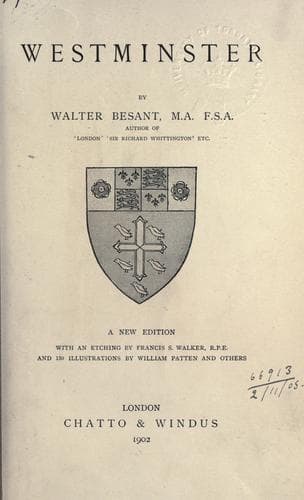
Westminster (London, England) -- Description and travel
The “Recuyell,” a translation, was completed in 1471. It was not printed
until 1474. The conclusion is that Caxton found so great a demand for it
that he could not get the book copied quickly enough to meet the demand;
that his attention was drawn to the newly invented art, and that he
perceived something of the enormous possibilities which it presented.
About this time he resigned the post he had held so long; he left the
claustral _Domus_ over which he had presided; he married a wife, and he
entered into the service of the Duchess of Burgundy. It has been asked
in what capacity he served. In no capacity at all; he was one of the
“following”; he wore the livery of the Duchess; he was attached to the
court; he had rooms and rations and some allowance of money; he was in
the service and at the orders of the Duchess; he was a secretary or an
interpreter; he swelled the pageant by his presence; he conducted the
Duchess’s trade ventures; he was Usher of the White Rod, Chamberlain,
Gentleman-in-waiting--anything. Do not let us be deceived by the word
“service” and its modern meaning.
[Illustration: FACSIMILE OF THE “RECUYELL OF THE HISTORYES OF TROIE.”]
This “service” lasted a very short time. He left the court--one knows
not why--and he returned, after this long absence, to his native land.
Then began the third, the last, the most important chapter of his life.
This was in the year 1476. He brought over his presses and his workmen
with him. And he settled in Westminster.
Why did he choose Westminster?
This point is elaborately discussed by Blades. He suggests that Caxton
went to Westminster on account of the wool staple, with which he may
have had
[Illustration: FACSIMILE OF THE “GAME AND PLAYE OF THE CHESSE.”]
correspondence while at Bruges. He _may_ have had; perhaps did
have--though it is not at all likely, because, as is most certain, he
was in constant correspondence with the Merchant Adventurers of London,
and with his own company of Mercers, whose representative he was; and
it is also certain that, as a citizen of London, he could not regard the
Staple of Westminster with any favor. That reason, therefore, may be
disregarded.
Or, Blades suggests, the Mercers rented of the Abbey a tavern called the
Greyhound, where they feasted once a year, and where they did business
with the merchants of the Wool Staple. _Therefore_ Caxton came here.
This, again, is a reason that is no reason; for, surely, the fact that
there was this tavern in Westminster could not influence Caxton in the
least. One might as well make him go to Gravesend because the Mercers
had a farm not far from the town.
Public-domain text, read in full here on John Shaqi.
Reviews
Reviews
No reviews yet
Be the first to share your thoughts on this work.
Elsewhere in the archive
Join the Discussion
Join the discussion
Sign in to leave a comment or review.
Sign InorCreate an account