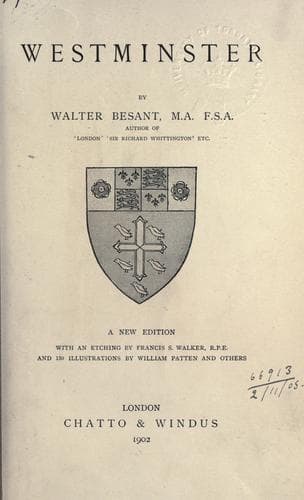
Westminster (London, England) -- Description and travel
Long afterward, until exactly fifty years ago, when it fell down, there
was shown a house traditionally assigned to Caxton. The representation
certainly indicates a later origin, but there may have been alterations.
There have been discussions and disputes over the site of the first
printing press: it has been placed on the site of Henry the Seventh’s
Chapel; one is told that the monument in front of St. Margaret’s stands
on the site. For my own part I cannot understand how there can be any
doubt at all. Stow, writing a hundred years later, states with the
greatest clearness where the house stood. He says, speaking of the “Gate
House,”--that is, the gate at the east end of Tothill Street: “On the
South side of this Gate King Henry VII. founded an Almshouse for
thirteen poor men ... near unto this house westward was an old chapel of
St. Anne, over against which the Lady Margaret, mother to King Henry
VII., erected an almshouse for poor women, which is now turned into
lodgings for the singing men of the College. The place wherein this
Chapel and Almshouse stand was called the Eleemosynary or Almonry; now,
corruptly, the Ambry; for that the alms of the Abbey were here
distributed to the poor.
“And therein Islip, Abbot of Westminster, first practised and erected
the first press of Book printing that ever was in England about the year
of Christ 1471; W. Caxton, Citizen of London, Mercer, brought it into
England, and was the first that practised it in the said Abbey.”
Islip was not Abbot at that time, but Prior and afterward Abbot. As
Prior, the details of the government of the Abbey were in his hands. If
now we look at the map we shall see that the place corresponds with what
was called the Great Almonry until a few years ago, when Victoria Street
was cut though the slums of Westminster, and the Westminster Palace
Hotel was built, either covering the site or effectually hiding it. The
thing does not seem to admit of doubt or dispute. Observe that Stow
speaks of the “Ambry” as being “in” the Abbey, though it was outside the
gate. So Caxton speaks of his presses as set up “in” the Abbey--an
expression which has led many to think that he carried on his work
within the church. The mistake was natural so long as men had forgotten
the meaning of the word “Abbey,” and thought that Westminster Abbey
meant the Church of St. Peter. How many are there, even now, who have
examined the remains lying south of the church, and who understand that
these were buildings which, with the church, constituted the Abbey?
The house was known by the sign of the Red Pale. It was a common sign
among printers in Holland, some of whom, however, had a Black Pale.
It is not necessary to enumerate the books which Caxton printed; and the
questions of type, process, binding, and illustrating must be left for
the biographer. But about the trade of printer and publisher? On this
point hear Caxton himself. He speaks in a Prologue (hitherto
undiscovered).
Public-domain text, read in full here on John Shaqi.
Reviews
Reviews
No reviews yet
Be the first to share your thoughts on this work.
Elsewhere in the archive
Join the Discussion
Join the discussion
Sign in to leave a comment or review.
Sign InorCreate an account