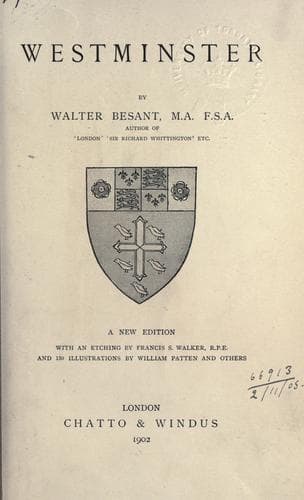
Westminster (London, England) -- Description and travel
was of crimson velvet, his shoes were set with gleaming diamonds, his
stirrups were silver gilt; before him rode two monks carrying silver
crosses. Every day he entertained a multitude with a noble feast and
fine wines, with the singing of men and children, and with the music of
all kinds of instruments. And afterward there were masques and
mummeries, and dances with noble dames and gentle damsels.
What have we to show in comparison with this magnificence? Nothing. The
richest man, the most noble and the most powerful, is no more splendid
than a simple gentleman. The King-maker, if he existed in the present
day, would walk to his club in Pall Mall; and you would not distinguish
him from the briefless barrister taking his dinner--the same dinner,
mind--at the next table. The decay of magnificence accompanies the decay
of rank, the decay of individual authority, and the decay of territorial
power.
Wolsey fell. Great and powerful must have been that dread sovereign,
that Occidental Star, that King who could overthrow by a single word so
mighty a Lord as the Cardinal. And the king took over for his own use
the town house of the Archbishops of York.
At this time the old Palace of Westminster was in a melancholy
condition. A fire in 1512 destroyed a great part of it, including the
principal offices and many of the chambers. The central part--the King’s
House--however, escaped, and here the King remained. Rooms for visitors
were found at Baynard’s Castle, Bridewell, and St. James’s (which was
built by Henry on the site of St. James’s Hospital). Norden, who wrote
in the year 1592, says that the old Palace at that time lay in ruins,
but that the vaults, cellars, and walls still remaining showed how
extensive had been the buildings in former times.
In converting York House into a Palace Henry added a tennis court, a
cockpit, a bowling alley, and a tilt yard. He built a gateway after
Holbein’s designs across the main street; and besides these, according
to the Act of Parliament which annexed Whitehall to the Palace of
Westminster, he “most sumptuously and curiously builded and edified many
beautiful, costly, and pleasant lodgings.” He laid out the Park, and he
began a collection of pictures, which Charles I. afterward enlarged.
James I. designed to erect a new and very costly Palace on the spot. He
intrusted the work to Inigo Jones, but the design never got beyond the
Banqueting Hall. Had the Palace been completed it would have shown a
front of 1152 feet in length from north to south, and 874 feet from east
to west.
Public-domain text, read in full here on John Shaqi.
Reviews
Reviews
No reviews yet
Be the first to share your thoughts on this work.
Elsewhere in the archive
Join the Discussion
Join the discussion
Sign in to leave a comment or review.
Sign InorCreate an account