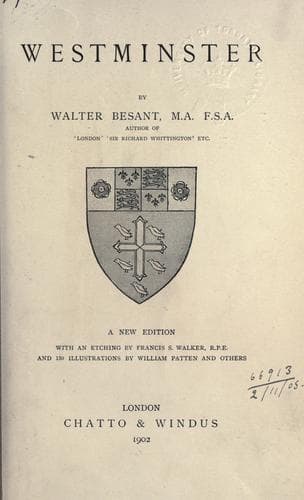
Westminster (London, England) -- Description and travel
These streets possessed, until quite recently, the picturesqueness that
belongs to the aged vagrom man. He hardly exists in these days; but one
remembers him. He was old--age had lent no touch of reverence or
dignity; he was clad in many-colored rags and fluttering duds; he leaned
upon a stick; his white locks were the only part of him that presented
any appearance of cleanliness; his face was lined and puckered, his
features were weatherbeaten and prominent, his eyes were wolfish. He was
admirable--in a picture. Such were the streets, such the houses, of
Westminster--that part of the City lying round about the Abbey. Those on
the west and south of the Abbey are comparatively new streets. In the
excellent map by Richard Newcourt showing London and Westminster in the
year 1658, we find Tothill Street completely built; Rochester Row does
not exist; Great St. Peter Street has a few houses, Great College Street
none; St. Anne’s Street has houses with gardens. The crowded part of
Westminster in the seventeenth century was that narrow area north of New
Palace Yard, of which King Street was the most important thoroughfare.
When we consider that this place was a great center of trade long before
and long after the building of London Bridge; that for six hundred years
it was close to the King’s House, with all his followers, huscarles,
archers, or bodyguard--we are not surprised that there has always been
about these streets the flavor of the tavern--always the smell of casks
and pint pots, of stale beer and yesterday’s wine. Where there are
soldiers there are taverns; there also are the minstrels and the music
and the girls. It may also be concluded beyond a doubt that the
Sanctuary was a thirsty place. Long after Court and Camp and Sanctuary
had left the place the name and fame of Westminster for its taverns and
its dens remained. These streets were a byword and a reproach well into
the present century. One or two streets there were that claimed for a
generation or so a kind of respectability. They were the streets lying
between New Palace Yard and Whitehall, such as King Street, and Cannon
Street, with one or two of later growth,--of seventeenth and eighteenth
century respectability,--such as Petty France, Cowley Street, and
College Street.
Public-domain text, read in full here on John Shaqi.
Reviews
Reviews
No reviews yet
Be the first to share your thoughts on this work.
Elsewhere in the archive
Join the Discussion
Join the discussion
Sign in to leave a comment or review.
Sign InorCreate an account