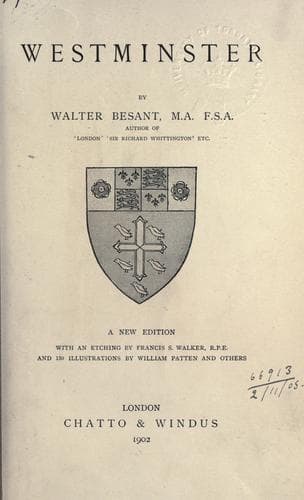
Westminster (London, England) -- Description and travel
the Restoration the Soldier once more became an Angel and the Citizen
returned to the Virgin Mary. But I think that the tavern languished.
Cowley Street was not named after the poet, as one would like to
believe, but after the village of Cowley, in Middlesex, by Mr. Booth
Barton, who built the two streets. There are other associations about
these streets; the name of Keats is mentioned. But they belong to the
catalogue. It is enough for us to recall the babbling brook which once
ran along the roadway here--on this side of the gray stone wall which
still stands, the wall of the Monastery. It ran then through the bending
reeds and the tall grasses of the marsh, and so out into the silver
Thames; the swans came sailing up the brook, and made nests in the low
bank of the eyot. The Abbot’s barge was moored close by the gateway, of
which a modern successor still stands; and there were drawn up on the
bank the boats in which the Abbot’s fishermen went out to catch salmon
and sturgeon in the river. Later on they built these quiet houses along
one side, something after the Dutch style; and they hung up before their
fronts a curtain of green Virginia creeper, but not to hide from the
windows the view of the broad lawns, the flower-beds, and the walnut
trees of the garden behind the wall.
This part of Westminster has always been full of taverns; first for the
solace of the men-at-arms, afterward for that of the Members of
Parliament. The tavern has always been the national place of recreation
and rest; for a time, it is true, the coffee-house displaced it, but
only for a time--the tavern came back again to favor. The signs of these
inns show the date of their erection. There was the White Hart of
Richard II.; the Brown Bear of Warwick; the White Swan of Henry V.; the
Old Rose of Henry VII. And there were the more common signs: the Blue
Boar, the Salutation, the George, the Green Dragon, The Barley Mow, the
Heaven tavern, the Fleece. One of the oldest of these taverns, the Cock,
remained with its open court and its galleries till twenty years ago,
when it was pulled down to make room for the Aquarium. The rafters and
timbers of this tavern were of cedar, and the interior was also adorned
with many curious carvings.
[Illustration: ORIGINAL SIGN, COCK INN.]
More remarkable than the taverns, which we have with us everywhere, were
the Almshouses of Westminster. Until they were destroyed they were
remarkable for their number, for their endowments, and for the quaint
pleasantness and beauty of their appearance. You may now look in vain
for the old buildings: they are gone; in their place we have the
consolidated almshouses and the consolidated schools.
Public-domain text, read in full here on John Shaqi.
Reviews
Reviews
No reviews yet
Be the first to share your thoughts on this work.
Elsewhere in the archive
Join the Discussion
Join the discussion
Sign in to leave a comment or review.
Sign InorCreate an account