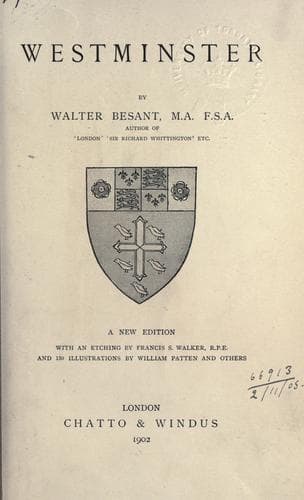
Westminster (London, England) -- Description and travel
the Palace of the Plantagenets; the Palace of the Stuarts; the Masques
of James I.; the Parliamentary side of the last century; and the streets
and slums. A great many things have been purposely omitted from these
pages which belong to Westminster and have taken place there. For
instance, there is the School with its long line of scholars, afterward
famous. Nothing has been said about the School. There is, again, the
Abbey Church. Very little has been said about the buildings; the
additions, alterations, restorations: nothing at all has been said
about the monuments which crowd its aisles and transepts. There is
Westminster Hall. Very little, indeed, has been said here of the things
done within its walls: the Coronation Banquets; the Trials; the
Receptions. Nothing has been said concerning the executions and the
tournaments which have taken place in Palace Yard, Old and New. Nothing
has been said about the New Houses of Parliament. These things, and a
great many more which the reader can remember for himself, have been
omitted from these pages, partly because they belong to the history of
this country and may be found in all Histories--they happened in
Westminster and they belong to Great Britain; partly because they have
already been so well treated that it is unnecessary and would be even
presumptuous for me to attempt them; and partly because the space at my
disposal is limited, though the materials are practically inexhaustible.
These chapters are not to be considered as a History of Westminster, or
a Survey: they are pictures of the City with its Palace, its Abbey, its
Sanctuary, and its slums, from a time when London did not exist until
the present day.
APPENDIX.
THE COURT OF CHARLES II.
The popular imagination pictures the Court of Charles the Second as a
place of no ceremony or state or dignity whatever; where the King
strolled about the courts and where there was singing of boys, laughter
of women, tinkling of guitars, playing of cards, making merriment
without stint or restraint, a Bohemia of Courts. We have been taught to
think thus of King Charles’s Court by the historian who has seized on
one or two scenes and episodes--for instance, the last Sunday evening of
Charles’s life; by the writer of romance; by the chronicler of scandal;
by the Restoration poets and the Restoration dramatists.
Public-domain text, read in full here on John Shaqi.
Reviews
Reviews
No reviews yet
Be the first to share your thoughts on this work.
Elsewhere in the archive
Join the Discussion
Join the discussion
Sign in to leave a comment or review.
Sign InorCreate an account