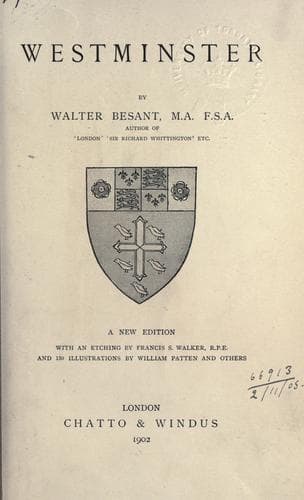
Westminster (London, England) -- Description and travel
Another breaking of sanctuary took place at the time of Wat Tyler’s
rebellion, when the unfortunate Marshal of the Marshalsea was dragged
from the Confessor’s shrine and murdered. But the rebels being dispersed
and their leaders hanged there was nothing more said.
Such events as these, from time to time, broke the monotony of the
monastic life. A coronation; a Royal wedding; a great funeral; the
flight of a Queen--Elizabeth Woodville: or a Duchess--as the Duchess of
Gloucester--to sanctuary; the death of a King--Henry IV.--in the Abbey;
these things gave the Brethren something to think about, something to
quicken the slow march of Time.
There were, and are, however, other residents of the Abbey besides the
monks; there are all the dead Kings and Queens and Princes; all the dead
nobles and the dead ignobles; the dead men of letters and the arts who
lie buried in this Campo Santo, the most sacred spot in all the Empire.
“Mortality, behold and fear!
What a change of flesh is here!
Think how many royal bones
Sleep within these heaps of stones.”
The verger will show us the Royal tombs and the Royal waxworks, with the
shrine of the Confessor, the armor of Henry V., and all the treasures
that lie behind those iron gates. We can see for ourselves the monuments
of the great unknown and the great illustrious who are buried in this
cemetery. We can read in the historians of the Abbey about the tombs and
the statues, the sculptors and the architects, the occupants and their
royal achievements.
Let us turn to the men of Letters and of Art. Here lies Chaucer; buried
in the church in the year 1400, not because he was a great poet, but
because he was one of the Royal household. The monument was erected in
the reign of Edward VI. Next to him lies Spenser, who died in King
Street close by. All the poets were present at his funeral; elegies
written by them for this occasion were thrown into the grave with the
pens that wrote them. The Countess of Dorset erected the monument. Then
come Drayton, Ben Jonson, Sir William Davenant, Abraham Cowley, John
Dryden--whose monument was raised by Sheffield, Duke of Buckingham.
This Sheffield raised: the sacred dust below
Was Dryden’s once:--the rest who does not know?
Public-domain text, read in full here on John Shaqi.
Reviews
Reviews
No reviews yet
Be the first to share your thoughts on this work.
Elsewhere in the archive
Join the Discussion
Join the discussion
Sign in to leave a comment or review.
Sign InorCreate an account