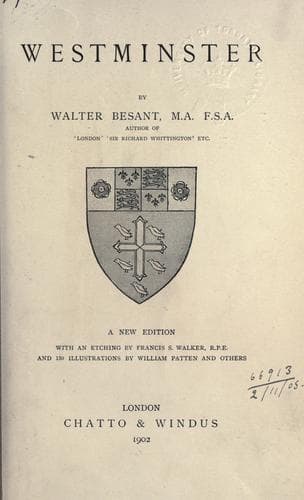
Westminster (London, England) -- Description and travel
But the lines were altered and Pope’s proposed epitaph did not appear.
John Milton’s bust was put up in 1737; his ashes lie in St. Giles’
Cripplegate. Here are that remarkable pair Aphra Behn and Tom Brown.
Here is Mrs. Steele, Dick Steele’s first wife, and here lies Addison,
the writer who is perhaps more loved than any other in our whole
literary history. They knew how to honor so great a scholar and an
essayist in the year 1719. His body lay in state in the Jerusalem
Chamber. They buried him in the dead of night--funerals in the
eighteenth century were often held at midnight when the darkness and the
gleaming torches added to the impressiveness of the ceremony. Bishop
Atterbury met the corpse; the choir sang a hymn, and the procession was
conducted by torchlight round the Royal Tombs into Henry VII.’s Chapel.
Tickell has written upon the scene:
Can I forget the dismal night that gave
My soul’s best part for ever to the grave?
How silent did his old companions tread
By midnight lamps the mansions of the dead;
Through breaking statues, these unheeded things,
Through rows of warriors and through walks of kings!
What awe did the slow solemn knell inspire,
The pealing organ and the pausing choir:
The duties by the lawn-robed prelate pay’d:
And the last words that dust to dust conveyed!
Matthew Prior and Gay followed Addison. Pope was buried at Twickenham;
Gray at Stoke Pogis; Goldsmith in the Temple. Samuel Johnson lies in the
Abbey; Sheridan, Cumberland, and Macpherson are buried here. And here of
moderns are Macaulay, Lord Lytton, Dickens, and Tennyson. Of actors and
actresses Anne Oldfield, Anna Bracegirdle, Betterton, Garrick, and John
Henderson are buried here. Of musicians Purcell, John Blow, William
Croft, Charles Burney, Sterndale Bennett, and Händel are buried here. Of
painters there are none. This is a very remarkable omission. How did it
happen? Presumably because the successive Deans and Canons have had no
taste for art.
The list includes a goodly company. Whenever a great man dies, the Dean
should remove a monument--one of the unknown--to make room for the
newcomer; in that way the Abbey would become more and more the Holy
Field of the British Empire.
One thing more before we leave the Abbey. We read of the mediæval
churches, especially such churches as old St. Paul’s, the Gray Friars,
and Austin Friars, how they were filled from end to end with tombs of
princes and noble ladies, carved and precious, with alabaster and
marble; how between and among the greater tombs were the tombs of the
lesser folk--but all of them, nobles and ladies and knights--the common
sort lay outside--insomuch that the church was filled with their
monuments. If we go into Westminster Abbey, alone of existing churches
we can understand this wealth of sepulchral monuments formerly so
common.
What says Addison?
Public-domain text, read in full here on John Shaqi.
Reviews
Reviews
No reviews yet
Be the first to share your thoughts on this work.
Elsewhere in the archive
Join the Discussion
Join the discussion
Sign in to leave a comment or review.
Sign InorCreate an account