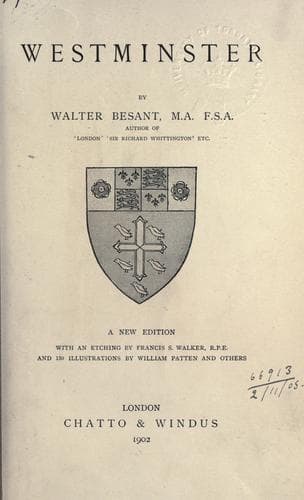
Westminster (London, England) -- Description and travel
“When I am in a serious humour I very often walk by myself in
Westminster Abbey. When the gloominess of the place, and the use to
which it is applied, with the solemnity of the building and the
conditions of the people who lie in it, are apt to fill the mind with a
kind of melancholy or rather thoughtfulness that is not disagreeable....
When I look upon the tombs of the great, every emotion of envy dies in
me; when I read the epitaphs of the beautiful, every inordinate desire
goes out; when I meet with the grief of parents upon a tombstone, my
heart melts with compassion; when I see the tombs of the parents
themselves I consider the vanity of grieving for those whom we must
quickly follow; when I see kings lying by those who deposed them, when I
consider rival wits placed side by side, or the holy men who divided the
world with their contests and disputes, I reflect with sorrow and
astonishment on the little competitions, factions, and debates of
mankind.”
CHAPTER V.
THE ABBEY--III.
The history of the successive Coronations performed in Westminster Abbey
from that of the Conqueror to the present day--especially those which
were picturesque--may be found in the pages of Stanley. There may be
read the dramatic Coronation of William the Conqueror; the joy of the
people at the Crowning of Queen Maude; the murder of the Jews at the
Coronation of Richard; here will be found Walpole’s account of the
Coronation of George III.; and the somewhat unworthy note on the
perspiring of George IV.
There are other points connected with the Coronations which may interest
us. Thus, the creation of knights at every Coronation was a custom both
graceful and symbolic. The candidate, after a bath, watched his arms all
night; in the morning he confessed and heard mass; he thus entered upon
his knightly duties cleansed and pure--body and soul; after the mass the
new king conferred knighthood and presented him with robes. At the
Coronation of Henry VI. there were thirty-six knights thus created; at
that of Edward IV., thirty-two; at that of Charles II., sixty-eight. The
part of the ceremony of a Coronation which most pleased the people was
the procession from the Tower to Westminster. That of Henry IV. is thus
described by Froissart:
Public-domain text, read in full here on John Shaqi.
Reviews
Reviews
No reviews yet
Be the first to share your thoughts on this work.
Elsewhere in the archive
Join the Discussion
Join the discussion
Sign in to leave a comment or review.
Sign InorCreate an account