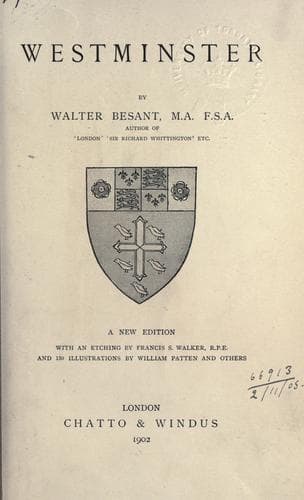
Westminster (London, England) -- Description and travel
The right of Sanctuary in a modified form lasted long after the
Dissolution of the Religious Houses. But when a great Abbey, as that of
Beaulieu, standing in a retired and unfrequented place, lay desolate and
in ruins, the right of Sanctuary was useless. No one was left to assert
the right--no one to defend it; there was neither roof nor hearth nor
altar. In great towns it was different; the Abbey might be desecrated,
but the Sanctuary house remained. Therefore on the site of St.
Martin’s-le-Grand, on the site of Blackfriars, and in Westminster round
that old fortress-church, still the debtors ran to escape the bailiffs,
and murderers and thieves hid themselves, knowing that the law was weak
indeed in the network of courts and streets which formed these retreats.
Other places pretended to immunity from the sheriffs; among these were
the streets on the site of Whitefriars, Salisbury Court, Ram Alley, and
Mitre Court; Fulwood’s Rents in Holborn, the Liberty of the Savoy, and,
on the other side of the river, Deadman’s Place, the Clink, the Mint,
and Montagu Close. The “privileges” of these places were finally
abolished in 1697.
* * * * *
It was in the year of our Lord 1520, on a pleasant morning in May, that
one who greatly loved to walk abroad in order to watch the ways of men,
and to hear them discourse, stood at the entrance of King Street,
[Illustration: THE COCK, TOTHILL STREET.]
where the gate called after the Cockpit hard by stood upon the bridge
which spanned the little stream flowing eastward to join the river. It
was a narrow street--on either side gabled houses. Courts still narrower
opened out to right and left. Lady Alley, where were almshouses for poor
women; Boar’s Head Court--in the years to come one Cromwell, Member of
Parliament, would live here; St. Stephen’s Alley; the Rhenish Wine yard;
Thieven’ Lane--a lane by which rogues could be taken to the Gate House
Prison without passing through the Precinct and so being able to claim
Sanctuary. There were taverns in it,--Westminster was always full of
taverns,--the Bell, the Boar’s Head, and the Rhenish Wine House. At the
south end stood the High Gate, built by Richard II. The visitor strolled
slowly down the street, looking curiously about him, as if the place was
strange. This indeed it was, for he had stepped straight out of the
nineteenth century into the sixteenth; out of King Street, mean and
narrow, into King Street, narrow indeed, but not mean. The roadway was
rough and full of holes; a filthy stream ran down the middle; all kinds
of refuse were lying about; there was no footpath nor any protection by
means of posts for foot passengers,--when a loaded wagon lumbered along
the people took refuge in the open doorway; when a string of pack horses
plodded down the middle of the street, splashing the mud of the stream
about it, the people retreated farther within the door. The street was
Public-domain text, read in full here on John Shaqi.
Reviews
Reviews
No reviews yet
Be the first to share your thoughts on this work.
Elsewhere in the archive
Join the Discussion
Join the discussion
Sign in to leave a comment or review.
Sign InorCreate an account