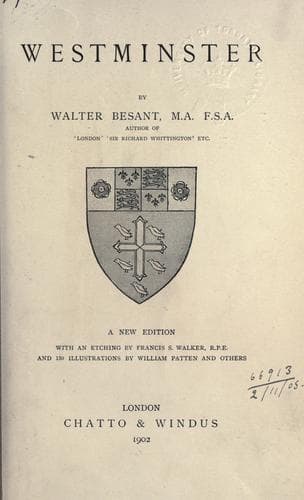
Westminster (London, England) -- Description and travel
change. Outside, in King Street, everybody was alert, the street was
filled with the happiness of life; the men-at-arms swaggered as they
rolled along, hand on sword hilt; the children ran about and laughed and
sang and shrieked for mere joy of living; through open windows, down
narrow courts, one could see men at work; the girls laughed and talked
as they went about the house, or leaned out of windows, or sat over
their sewing; life was at full flow, like the broad river beyond. But
here--it was a City of Silence. The men stood at the doors moody and
silent; the women in the house went about their work in moody silence;
the very children rolling in the dust of the foul lanes had forgotten
how to laugh; there were no cheerful sounds of work; there were no
swash-bucklers, there were no roysterers, there were no taverns; the men
carried no arms, they wore no liveries, except the Sanctuary gown with
the keys of the Abbey worked in white on the left shoulder; they were
apparently plain burgesses of the humbler sort, craftsmen, or keepers of
shops and stalls. A strange place! A city apart; a city of melancholy; a
city of restlessness and discontent. For the most part the men sat or
walked apart; but here and there were groups of twos and threes who
whispered with each other, and showed things secretly under cover of
their gowns. Villainous faces they wore, and when they walked it was
after the manner of the wild beast which slinks behind the rocks.
The visitor found himself before the great square Tower of which we have
already spoken. Gloomy and threatening it looked down upon the tenements
below, with its belfry in one corner, its single door, its two windows
above, its stair tower beside the door, and its blackened massive walls.
As he stood there, wondering and trying to understand this strange
world, the door was opened, and a man came forth.
He was dressed as an ecclesiastic, in a black gown; on his left shoulder
he wore the keys in white; he was old and somewhat bent; a man of the
middle height; the thin hair that showed from under the cap was white;
his nose was broad and somewhat flat; his eyes were large, and when he
spoke they became luminous and smiling; his voice was still young, and
his laugh was ready--a thing unusual in a man when he is past fifty; but
this man was close upon seventy--the allotted span. He was so near his
end, and yet he laughed. It is given to few among mortals to find aught
that makes for mirth after the days of boyhood. Mostly their days are
full of misery: men of violence rob them; kings and barons drive them
forth to war; they are flogged and set in pillory and are clapped in
prison. How should they laugh, when all they desire is rest, when they
rejoice exceedingly and are glad if they think the grave is near?
This man, as he came forth from the Sanctuary, espied the visitor, and
greeted him.
Public-domain text, read in full here on John Shaqi.
Reviews
Reviews
No reviews yet
Be the first to share your thoughts on this work.
Elsewhere in the archive
Join the Discussion
Join the discussion
Sign in to leave a comment or review.
Sign InorCreate an account