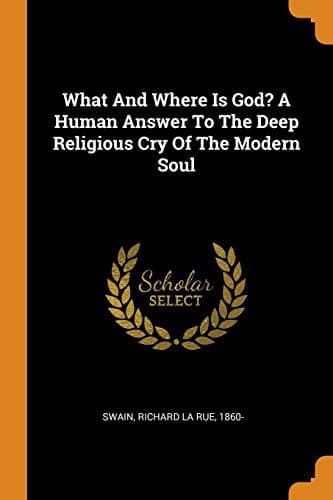
What and Where is God? A Human Answer to the Deep Religious Cry of the Modern SoulSwain, Richard La Rue
Religion
What and Where is God? A Human Answer to the Deep Religious Cry of the Modern Soul
Swain, Richard La Rue
Christianity; God (Christianity)
After much study, the Church Fathers arrived at the conclusion that God
was somehow Three in One, a sort of society within Himself,--and they
were right. For without something like a social experience in one's
self, it is impossible to be a person at all. This is equally true of
God or man. To be a person one must know himself, and this he could not
do if he were not able to keep company with himself. The pen with which
I am writing is not a person because it has no capacity for
self-communion. But because I hold _fellowship_ with myself I am a
person. Since every human being keeps company with himself more than he
does with all other persons put together, may God have mercy on him if
he is bad company, if he is not safe to be left alone with himself. A
tree may stand alone in infinite solitude, companionless; but for
better, for worse, a man must forever remain in his own company,
hearing praise or condemnation from his own heart. How is this possible,
unless there is something in a man's individual experience that
resembles society? In self-knowledge, as in all knowledge, there are the
_knower_ and the _known_. When we commune with ourselves we are, at the
same moment, the subject and the object of our own experience. The self
that sees may fittingly be called the father of our personality, and
with equal propriety the self that we see may be called the begotten of
our personality. Thus something resembling father and son is experienced
in our first step toward self-knowledge. Whether the capacity to be our
own subject and object amounts to much or little, it was this that the
Fathers saw and rightly attributed to God.
Furthermore, there is yet another step to be taken in the act of coming
to true self-knowledge. By what power does one determine that the person
with whom he communes is himself? There is something in our experience
resembling a third person, one who recognizes both subject and object
and bears witness that they are one. The reader may say, "I can see the
first and the second, but I cannot see the third." The self that sees
the first and the second is the third. This power by which we complete
the unity of our being is by no means trivial, as some may think. There
are abnormal personalities who successfully achieve the subjective and
objective in their experience and keep up an abnormal communion with
themselves from morning till night, who cannot witness true. So they
insist that they are "General Jacksons" or "Jesus Christs" or great
"railroad magnates." Their personalities have broken down, not because
they lack self-consciousness, but because they lack the power of coming
to unity. A perfectly sane person, therefore, is subject, object, and
witnesser all in one. If God were not this kind of trinity He would not
be a person at all.
Public-domain text, read in full here on John Shaqi.
Reviews
Reviews
No reviews yet
Be the first to share your thoughts on this work.
Elsewhere in the archive
Join the Discussion
Join the discussion
Sign in to leave a comment or review.
Sign InorCreate an account