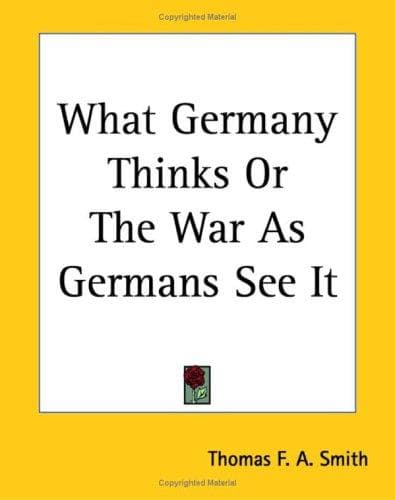
What Germany Thinks; Or, The War as Germans see itSmith, Thomas F. A.
History
What Germany Thinks; Or, The War as Germans see it
Smith, Thomas F. A.
World War, 1914-1918
Another link in the chain of proof of Britain's guilt, is found in the
documents seized by the Germans in Brussels. The enemy seems to attach
great importance to them, for they are being employed in much the same
way that parliamentary candidates use pamphlets during an election. Yet
they do not contain a particle of proof that Britain had hostile
intentions against Germany, but only confirm the presence of the German
menace.
The documents[198] in question are reports sent by the Belgian Legation
Secretaries in London, Paris and Berlin to the Minister for Foreign
Affairs in Brussels. These gentlemen held opinions identical with those
expressed again and again in German newspapers, and even in some British
and French organs. Messieurs Comte de Lalaing (London), Greindl
(Berlin), Leghait (Paris), evidently believed that the activities of the
Triple Alliance and the Triple Entente endangered the peace of Europe.
[Footnote 198: Published by the Berlin Government as supplements to the
_Nord-deutsche Allgemeine Zeitung_, July 29th and 31st; August 4th, 8th
and 12th, 1915.]
Further they believed the latter constellation to be the more aggressive
of the two, and formally reported these convictions to the Belgian
Government. If read as a modern edition of "Pepys' Diary" they form
entertaining literature, but by no stretch of the imagination could they
be classed as historical sources. A gentleman who reports to his
Government that King Edward took breakfast in company with M. Delcassé
and that the Press had neglected to chronicle the incident, can hardly
rank as an historian.
Moreover, it is by no means clear why the German Press should laud M.
Greindl as a gentleman of German origin. If this be true it would
probably explain everything which deserves explanation in the said
documents, and would probably account for the intimate, confidential
treatment which M. Greindl received at the hands of German officials.
German newspapers are gloating over the fact that the British Government
has not deigned to reply to these "revelations." There is really nothing
to which it can reply; three observers expressed their opinion on
contemporaneous happenings during the years 1905-1911. But a brutal
sequence of events in 1914 showed them--if they had not been convinced
during the preceding three years--that they had drawn false conclusions
from their observations.
To return to the last trial of strength between the two groups of
European Powers, it is interesting to note that Professor Oncken denies
German participation in formulating the ultimatum to Serbia, or that
Germany was aware of its contents. Germany merely left Austria a free
hand in the matter. Oncken endeavours to show that Austria's demands
were not excessive, and expresses astonishment that the opposing Powers
found them exorbitant. He does not mention the fact that a large section
of the German nation held the same opinion on July 25th, 1914.
Public-domain text, read in full here on John Shaqi.
Reviews
Reviews
No reviews yet
Be the first to share your thoughts on this work.
Elsewhere in the archive
Join the Discussion
Join the discussion
Sign in to leave a comment or review.
Sign InorCreate an account