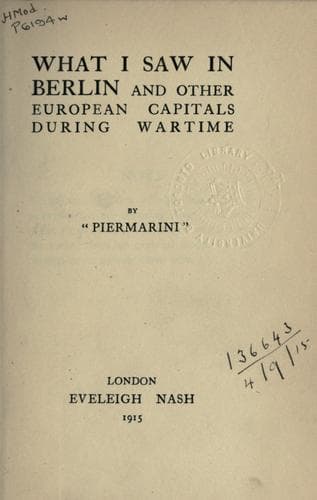
What I Saw in Berlin and Other European Capitals During WartimePiermarini
History
What I Saw in Berlin and Other European Capitals During Wartime
Piermarini
Europe -- Description and travel; World War, 1914-1918 -- Personal narratives
It is the middle class which is said to be suffering most under these
conditions, for they have no money in the bank, they hardly manage to
make any money at all at the present moment, and, at the same time,
they don't want to admit that they are in need of anything.
Vienna has, at the present moment, scores of families--well-dressed and
well-connected--who are starving at home, families which, before the
war, used to live up to their full income and generally above it, and
which, now the father is unemployed or at the front, are absolutely
penniless and too proud to accept anything from public charity.
But the Viennese is certainly one of the most light-hearted persons on
earth--the war is going badly, the town is full of starving people,
the empire is engaged in a dangerous adventure, the end of which he
does not take the trouble to prognosticate; but what does it matter? He
talks about the war to crack a joke on the subject; he sees and laughs
at the faults of his allies; he manages to have a good time as far as
possible. The few theatres left open are crowded, as well as the cafés,
the cabarets, and all other places of amusement.
About politics, or the conduct of the war, he does not care to talk.
The argument is sad and it is not even very safe to say exactly what
one thinks on the subject.
If anybody is heard talking pessimistically about the war he is
denounced to the authorities. A case is made against him, and the
imprudent chatterer is almost certain to be condemned. I know of a
man who got two months' imprisonment for having said that he did not
believe the newspapers.
* * *
Besides the hospitals fixed up in numerous picture-galleries,
theatres, university buildings and private houses, the Prater's
constructions given up to depôts, magazines, and aeroplane sheds,
and the complicated system arranged for the collection of money and
comforts for the troops, all of which have altered considerably the
general appearance of the city, the thing which astonished me most
was the activity of a society which bears the harmonious name of "K.
u. K. Oesterreich-Ungarischer-National-Sprachen-Gebrauchs-Verein,"
the nearest translation of which I can think of is "Society for the
exclusive use of the national language in the Austro-Hungarian Empire."
Vienna is certainly one of the towns outside France which shows a
strong French character, and the language, as well as the life of the
whole city, bears evident marks of it. Well, this society wants to rid
the Viennese slang of French words, as well as of all words not in the
German dictionary. The first effects of this movement have been to make
numerous hotels, cafés, and cabarets change names, and the publication
of pamphlets, distributed freely all over the town, in which are full
lists of the _taboo_ words, as well as of the numerous French and
English Christian names which are quite usual in Vienna, and which, it
is requested, should now be given up.
Public-domain text, read in full here on John Shaqi.
Reviews
Reviews
No reviews yet
Be the first to share your thoughts on this work.
Elsewhere in the archive
Join the Discussion
Join the discussion
Sign in to leave a comment or review.
Sign InorCreate an account