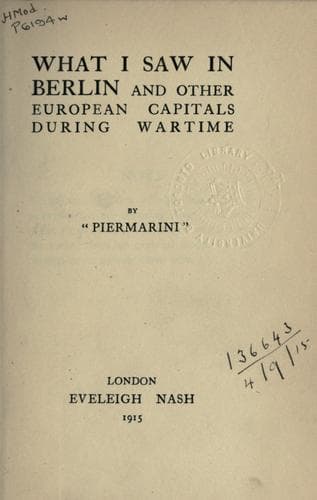
What I Saw in Berlin and Other European Capitals During WartimePiermarini
History
What I Saw in Berlin and Other European Capitals During Wartime
Piermarini
Europe -- Description and travel; World War, 1914-1918 -- Personal narratives
Without England or France having supported them, or even treated
particularly well their correspondents (many Italian journalists,
Barzini included, were arrested and sent back to Paris when found
too near the front), the Italian Press, with few and not important
exceptions, has opposed the idea of neutral policy. One of the most
important of Italian journals printed as a sub-title to its heading
in big type the sentence of Machiavelli: "Neutrality is never suitable
to a nation, for a State who keeps neutral loses her friends, does not
gain advantages and, when the war is over, ingenerates such diffidence
about her future conduct that no other nation cares to conclude an
alliance with her."
Germany and Austria, recognising the trend of public opinion in
Italy, did not economise money or trouble in an endeavour to change
its course if possible. Two or three newspapers were bought by a sort
of secret trust which depends upon "Palazzo Venezia," the Austrian
Embassy in Rome; some others were largely subventioned; news made
in Germany was sent out, not only to all newspapers, but to private
houses. A friend of mine kept a full collection of such pamphlets right
from the beginning of the war. The circulars are issued every two or
three weeks, and generally begin with a formal denial of everything
that has been stated by the French, English, and Russian official
bulletins. Accusations of pillage, robbery, murder, and cruelties of
every possible kind are made against the Allies, and are _proved_ by
bogus letters from German officers and soldiers. This system, though it
certainly does not succeed amongst the more educated classes, scores
a little more amongst the lower-class folk, who are highly flattered
to see amongst their weekly correspondence a large letter bearing for
crest the Austrian or German eagle.
Another system largely employed by Germany in their attempted work of
modifying Italy's public opinion is the free supply of photographs
and sketches to illustrated newspapers. Above all, however, they have
concentrated their endeavours upon the kinema.
The picture-house has ceased to be the means of spending an hour far
from business and worry, in a restfully darkened room, watching a
moderately amusing and, possibly, highly moral film, which does not
suffer if one misses part of it. Now it has become an instrument used
by Governments for educating the people.
Germany produces a large number of war films, both for home display
and for abroad. There are descriptive, allegoric, sentimental, even
comic films inspired by the war: the soldiers of the Kaiser do the most
wonderful things. They are strong, generous, good-humoured. Most of
these scenes are arranged, and only slices of real life in the case of
military revues and parades are introduced.
Public-domain text, read in full here on John Shaqi.
Reviews
Reviews
No reviews yet
Be the first to share your thoughts on this work.
Elsewhere in the archive
Join the Discussion
Join the discussion
Sign in to leave a comment or review.
Sign InorCreate an account