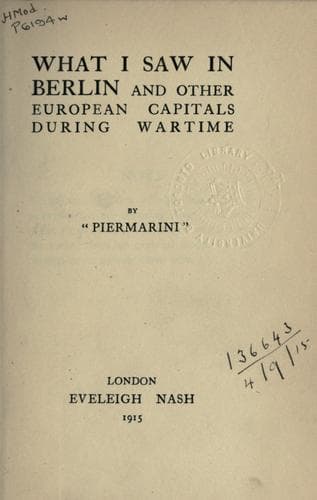
What I Saw in Berlin and Other European Capitals During WartimePiermarini
History
What I Saw in Berlin and Other European Capitals During Wartime
Piermarini
Europe -- Description and travel; World War, 1914-1918 -- Personal narratives
But they were only allowed to see parades and specially prepared
trenches, or batteries which had never been exposed to the fire. They
were shown a concentration camp, but were not allowed to speak to the
prisoners. They were taken to Liège to see the forts, but not to the
destroyed towns in Belgium. Then they had to go back to Berlin and were
kept there in one of the principal hotels, waiting for the moment when
everything should have been arranged for them on some quiet spot of
the Russian frontier. The tour came to a sudden and rather unfortunate
end, as the journalists, having realised that they were allowed to see
nothing of interest, but only what pleased Herr Sweinhart, decided to
return to Italy at their own expense, and did not write a line about
their experiences so as not to excite the hearty laughter of their
wiser colleagues.
The cleverest move of the Austro-Germans in the direction of keeping
Italy quiet as long as possible was certainly the sending of von Buelow
to Rome as German Ambassador.
The personal charm of this clever diplomat probably accounts for
Italy's attitude during the last months. He acted, and is still acting,
like a rubber cushion between the Teutonic ruggedness and the Italian
susceptibility.
* * *
In the little "Trattoria" near Piazza Colonna, in which most
parliamentary men meet in preference to the big, gilded, French-style
restaurants, where the food is excellent, the wine taken with a gay
murmur from large barrels showing at the back, and where hardly any
"outsider" or any foreigners dare enter, so modest is the appearance of
the establishment, half-a-dozen world-known writers, politicians, and
journalists were enjoying a "fritto di pesce," abundantly accompanied
by the light wine, "delli Castelli." The subject of the conversation
was, of course, the war. All the sympathies were on the side of the
Entente. A copy of _The Times_ was passed from one to another, and
the most important news was translated for the benefit of the few of
the company who were not familiar with English. A well-known writer
of military criticism in one of the principal Italian papers, a
former Major in the army, produced a letter from one of his sons,
now fighting with the French army in Alsace. The letter was very
enthusiastic about everything and everybody at the front; the young
man was one of the very last to manage to join the voluntary corps,
Italy having, since December last, stopped completely the granting of
passports to young men liable for military service.
The wonderful work of the "Dante Alighieri," the society which has been
struggling hard during the last years to keep the Italian language
alive in the provinces under foreign domination, the last poem of
D'Annunzio on the war, the concentration of troops near Verona, were,
in turn, subjects of conversation. I got the impression that for them
the question was not, "Are we going to war?" but, "When are we going to
war?"
Public-domain text, read in full here on John Shaqi.
Reviews
Reviews
No reviews yet
Be the first to share your thoughts on this work.
Elsewhere in the archive
Join the Discussion
Join the discussion
Sign in to leave a comment or review.
Sign InorCreate an account