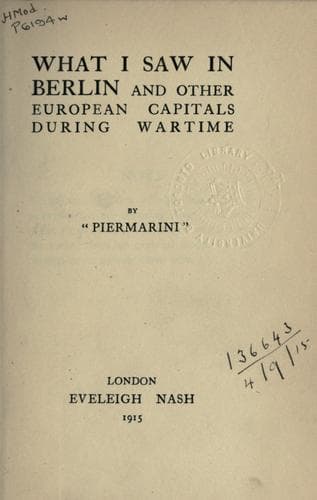
What I Saw in Berlin and Other European Capitals During WartimePiermarini
History
What I Saw in Berlin and Other European Capitals During Wartime
Piermarini
Europe -- Description and travel; World War, 1914-1918 -- Personal narratives
Nice has, at the present moment, five or six thousand refugees, and
more are expected. I saw groups of them walking along the long dusty
road that runs at the side of the Paillon, the little torrent which, in
winter, looks quite a respectable river.
Here is nothing of the Nice that English people know; no hotels, no
palm trees, no flower-beds, no smart shops.
The town in its eastern part has preserved its look of sixty years ago,
the only new constructions being two huge hive-like barracks. It is
probably uglier and dirtier than the commercial quarter of Marseilles
itself.
The refugees have chosen as their favourite promenade this dingy
quarter. Here they meet the soldiers who are coming back or are going
to their country, here the Corporation of Nice distributes twice a day
free soup to the poor.
The refugees are not often seen in the smart part of the town.
The Promenade des Anglais, the Jetée, and the Place Massena are a
background too much in contrast with their ragged clothes. They don't
care to walk near the well-dressed people lounging in basket-chairs
along the promenade.
Most of the refugees have taken with them all they could manage to
carry, and it is touching to see how, amongst all their troubles,
seldom have they forgotten the little mongrel dog, faithful companion
in the happy days before the war.
I was contemplating the refugees, and walking down the irregular
pavement of a Genoese-looking street, when a strange sight met my eyes.
Behind a brick wall an extraordinary structure of long wooden bars,
osiers, canes, wire-work, and such-like material, emerged and reached a
height of perhaps twenty feet.
After a minute's uncertitude, I remembered that I was in Nice, the
motherland of the famous Carnival. This complicated construction could
only be the skeleton of His Majesty King Carnival himself, the jolly
deity who presides at the Riviera winter festivities.
"I thought you always burnt your King Carnival at the end of the
season," I said to a native. "How is it that you preserved last year's
dummy?"
"This, sir," he answered, "is not the last Roi Carnival, but the next
Roi Carnival. Nobody thought we were going to take him round the town
this year, but we shall probably have him finished up with canvas and
plaster all the same.
"Of course, it will not be one of our great Carnivals; we have no money
to throw away this winter, but His Majesty will go round the streets
with a German helmet on his head and two upstanding moustaches, and
everybody will enjoy more than usual the moment, at the beginning of
Lent, when the figure will be set on fire."
Really, Nice does not look like a town which will, this year, have
festivities of any kind. There are too many wounded and too many
hospitals; the restrictions imposed by the Government are too strict,
and the people do not seem to want any such amusement. Most of the
luxury shops remain closed, and there is no chance of having an opera
season or the famous Veglione at the Opera.
Public-domain text, read in full here on John Shaqi.
Reviews
Reviews
No reviews yet
Be the first to share your thoughts on this work.
Elsewhere in the archive
Join the Discussion
Join the discussion
Sign in to leave a comment or review.
Sign InorCreate an account