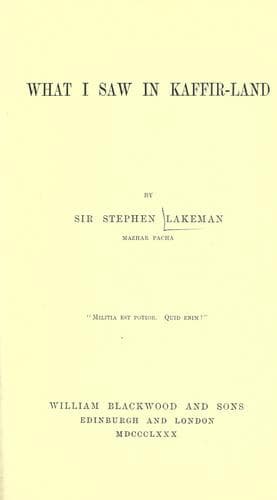
South Africa -- History -- Frontier Wars, 1811-1878
“You see what divisions sever the leaders; how then can we expect the
flock to follow them into one fold? No, no; we priests divide in order
to reign. Unity of the Church can only be obtained by people going to
Christ without waiting for us. None of us can define, with convincing
simplicity to the masses, what authority we really possess as delegates
of our Saviour. I for my part am willing to hold out the hand of
fellowship to all men, even to those erring brethren the Jews. In a
few days I shall pronounce in the Senate a speech in favour of their
admission into this country as citizens. I must confess that in this
I have listened more to the voice of Christianity in the West than in
this part of the world. It is difficult for us Roumanians to look upon
the Jew as a brother who looks upon our Saviour as an impostor. Yet
still I have persuaded myself to perform this ill-defined task. I only
trust in God that the passing of the measure will not tend to increase
free-thinking doubt. I would even open my seminaries to the Jews, so
much do I long to see all men brethren, but they would not come to
them; neither do I regret it, for the orthodox Church ought, I think,
to remain in the present what she has been in the past--a prudent,
wise, and charitable mother, seeking to govern her own children wisely,
leaving other Churches to do the same with theirs.
“I shall go to England next year if my health allow; and although I
shall try and convert no one, I hope there will be no necessity for
conversion to convince English prelates that they have in me a true
Christian brother.”
The English prelate was a kind-hearted, learned man, full to
overflowing with a wish to do good, but evidently puzzled how to
set about it. There is a patriarchal vigour about some of the older
forms of belief, which, in its racy _bonhomie_, dwarfs Anglicanism
considerably, and makes it look somewhat of a sect--true, a good
one, as, from the power and influence at its disposal, it would be
strange if it were not; yet in a contrast like the above, it must be
confessed that it has, outwardly at least, a rather “Brummagem” look.
The Protestantism of Germany, in spite of its dreary aspirations,
has a much broader basis. It encourages an untrammelled intercourse
between thinkers of all denominations. There is an ebb and flow of
ideas going on between it and the older forms of religion in the East
which merit the attention of all who follow the outward growth and
forms of Christianity. I have attended a Protestant service in the East
where more than half of a large congregation were members of the Greek
Church; and of the many members of that community with whom I have come
into contact, and with whom I have spoken on the subject of religion,
none seemed to dislike, and many seemed to like, the Saxon form of
Protestantism as it exists in Transylvania; and I must testify that a
better class of men than there produced under this form of religion it
would be difficult to find anywhere.
Public-domain text, read in full here on John Shaqi.
Reviews
Reviews
No reviews yet
Be the first to share your thoughts on this work.
Elsewhere in the archive
Join the Discussion
Join the discussion
Sign in to leave a comment or review.
Sign InorCreate an account