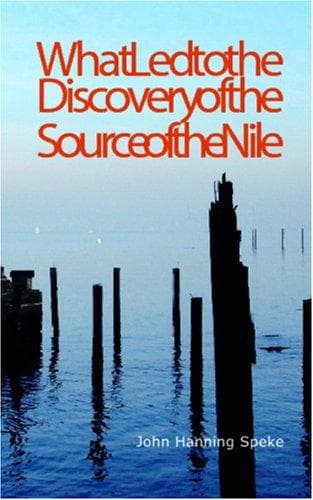
What Led to the Discovery of the Source of the NileSpeke, John Hanning
History
What Led to the Discovery of the Source of the Nile
Speke, John Hanning
Horn of Africa -- Description and travel; Nile River; Tanganyika, Lake
excursions under the lee of the Sagama hill, in quest of rank grasses
and forest-trees growing there, which compose his ordinary food, to
make for a certain deep place in the river, by which means he would
have to cross the plain exactly where they posted themselves: they
were not mistaken. The beast advanced at the usual time for going to
his watery abode, and the savages at once surrounded him on the plain;
by firing arrows from all sides at once in rapid succession, the huge
awkward beast knew not which man to set on first, and in its constant,
fruitless, angry endeavours to reach the last assailant, he soon
became exhausted, and was eventually overpowered.
We now passed on to the nullah, followed it down to the place of
bivouac, found the compass, and returned. In the bed of the nullah
there were numerous pools, both large and small, but all were rapidly
drying up, and destroying the numerous fish they contained; for as
this desiccation increased, and the pools became smaller, the fervid
sun heated the little remaining water to such an overpowering extent,
that the fish, half suffocated, turned on their backs and became an
easy prey to the numerous green-and-brown-striped iguanas that eagerly
thronged their brinks for food. As we approached, these horrid-looking
reptiles hurried off like frightened cats to their hiding-places, some
bearing fish away in their mouths, whilst others, less composed,
dropped what they had half devoured, to evade us all the more readily.
This intense fear of man is caused by their being the negro's game,
who eat them with the same kind of pleasure and relish which a
Frenchman has for frogs. Cheerily did we trip along, for
Bombay--astonished at my oddities or peculiarities, as he thought
them, when I picked up a river shell, or dilated much on the antelopes
and birds we sometimes saw--broke into a series of yarns about his
former life, and of the wild animals with which he was familiar in his
fatherland. He seemed to me a surprisingly indefatigable walker, for
he joked and talked and walked as briskly at the end of thirty miles
as he did at starting. As the sun was setting we repassed the place
where the hippopotamus had been slain, but not a vestige of his flesh
or a bone remained to mark the place--every morsel had been carried
off for food. Ferrying across the river, we were heartily met by the
boisterous, mirthful Sultan Momba, who instantly on our landing shook
us heartily by the hand, commented on our walking powers with
enthusiastic pride, invited us to his palace (grass hut), and gave us
a royal repast.
Public-domain text, read in full here on John Shaqi.
Reviews
Reviews
No reviews yet
Be the first to share your thoughts on this work.
Elsewhere in the archive
Join the Discussion
Join the discussion
Sign in to leave a comment or review.
Sign InorCreate an account