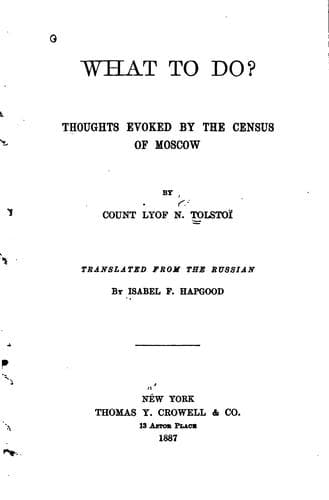
What to Do? Thoughts Evoked by the Census of MoscowTolstoy, Leo, graf
Philosophy
What to Do? Thoughts Evoked by the Census of Moscow
Tolstoy, Leo, graf
Moscow (Russia) -- Social conditions; Social problems
I remember that during the entire period of my unsuccessful efforts at
helping the inhabitants of the city, I presented to myself the aspect of
a man who should attempt to drag another man out of a swamp while he
himself was standing on the same unstable ground. Every attempt of mine
had made me conscious of the untrustworthy character of the soil on which
I stood. I felt that I was in the swamp myself, but this consciousness
did not cause me to look more narrowly at my own feet, in order to learn
upon what I was standing; I kept on seeking some external means, outside
myself, of helping the existing evil.
I then felt that my life was bad, and that it was impossible to live in
that manner. But from the fact that my life was bad, and that it was
impossible to live in that manner, I did not draw the very simple and
clear deduction that it was necessary to amend my life and to live
better, but I knew the terrible deduction that in order to live well
myself, I must needs reform the lives of others; and so I began to reform
the lives of others. I lived in the city, and I wished to reform the
lives of those who lived in the city; but I soon became convinced that
this I could not by any possibility accomplish, and I began to meditate
on the inherent characteristics of city life and city poverty.
"What are city life and city poverty? Why, when I am living in the city,
cannot I help the city poor?"
I asked myself. I answered myself that I could not do any thing for
them, in the first place, because there were too many of them here in one
spot; in the second place, because all the poor people here were entirely
different from the country poor. Why were there so many of them here?
and in what did their peculiarity, as opposed to the country poor,
consist? There was one and the same answer to both questions. There
were a great many of them here, because here all those people who have no
means of subsistence in the country collect around the rich; and their
peculiarity lies in this, that they are not people who have come from the
country to support themselves in the city (if there are any city paupers,
those who have been born here, and whose fathers and grandfathers were
born here, then those fathers and grandfathers came hither for the
purpose of earning their livelihood). What is the meaning of this: _to
earn one's livelihood in the city_? In the words "to earn one's
livelihood in the city," there is something strange, resembling a jest,
when you reflect on their significance. How is it that people go from
the country,--that is to say, from the places where there are forests,
meadows, grain, and cattle, where all the wealth of the earth lies,--to
earn their livelihood in a place where there are neither trees, nor
grass, nor even land, and only stones and dust? What is the significance
of the words "to earn a livelihood in the city," which are in such
constant use, both by those who earn the livelihood, and by those who
Public-domain text, read in full here on John Shaqi.
Reviews
Reviews
No reviews yet
Be the first to share your thoughts on this work.
Elsewhere in the archive
Join the Discussion
Join the discussion
Sign in to leave a comment or review.
Sign InorCreate an account