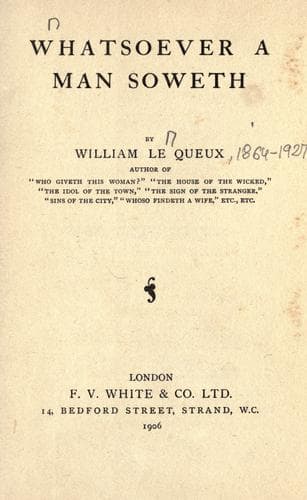
London (England) -- Fiction; Man-woman relationships -- Fiction; Mystery fiction
While the constable Marvin repacked the precious box to replace it,
Pickering and myself went to the drawer and looked over the letters.
Many of them were unimportant and incomprehensible, until one I opened
written upon blue-grey notepaper bearing the heading: "Harewolde Abbey,
Herefordshire." It was in the well-known handwriting of Sybil Burnet!
Amazed, I read eagerly as follows:--
"Yes. Fred Kinghorne is here. He is an American, and beyond the
Marstons has, I believe, no friends in England. He is an excellent
bridge player and has won heavily this week. He has told me that he is
engaged to a girl named Appleton, daughter of a Wall Street broker, and
that she and her mother are to meet him in Naples on the twentieth, for
a tour in Italy. He leaves here next Saturday, and will stay at the
Cecil for ten days prior to leaving for Italy. He is evidently very
well off, and one of the reasons he is in England is to buy some
jewellery as a wedding present for his bride. The Marstons tell me that
he is the son of old Jacob Kinghorne, the great Californian financier.
I hope this information will satisfy you.--S."
Harewolde, as all the world knows, was one of the centres of the smart
set. The Marstons entertained the royalties frequently, and there were
rumours of bridge parties and high stakes. Why had Sybil given this
curious information? Had the young man Kinghorne been marked down as
one of the victims and enticed to that fatal house?
There was no envelope, and the commencement of the letter was abrupt, as
though it had been enclosed with some unsuspicious communication.
Having read it, I laid it down without comment, for it was my last
desire to incriminate the poor unhappy woman, who, shorn of her
brilliancy, was now leading such a strange and lowly life in that dull
South London street.
Yet could it be possible that she had acted for these blackguards as
their secret agent in society?
The suggestion held me stupefied.
At last Edwards ascended the stairs with Horton and another constable in
plain clothes, and scrambled across the settle to where we stood. He
carried in his hand a strong ladder of silken rope--which Pickering
incidentally remarked had once been the property of Crisp, the notable
Hampstead burglar--together with another lantern, a ball of string and a
length of stout rope.
Marvin and Edwards recrossed the improvised bridge, while Pickering,
Horton and myself remained upon the landing. Then, when we drew the
settle away the two men pressed upon the stairs, causing the whole to
move forward upon the hinges at the edge of the landing and disclosing
the black abyss. As soon as the pressure was released, however, the
stairs swung back into their place again, there being either a spring or
a counter-balancing weight beneath.
Public-domain text, read in full here on John Shaqi.
Reviews
Reviews
No reviews yet
Be the first to share your thoughts on this work.
Elsewhere in the archive
Join the Discussion
Join the discussion
Sign in to leave a comment or review.
Sign InorCreate an account