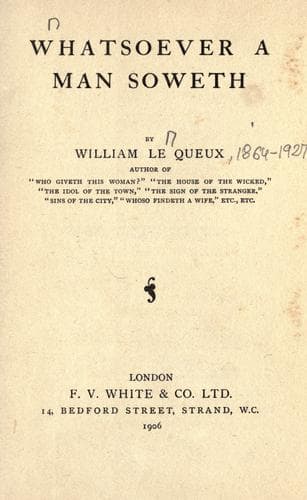
London (England) -- Fiction; Man-woman relationships -- Fiction; Mystery fiction
"No. The error is mine, and I must bear the punishment. Ah!" she
cried, suddenly starting up, placing both palms to her brow, and pacing
up and down the little room. "Ah! you don't know what I suffer. Day
and night I sit here and think and think, and wonder, and fear. Yes!"
she cried, her eyes starting as she glared at me in her desperation. "I
fear! I fear lest I may be discovered by those enemies who have sworn
to effect my ruin! But--but you will save me, Wilfrid," she gasped,
suddenly advancing, turning her white face to mine, and clutching my
hand. "You will protect me from them, won't you?"
"Of course," I answered, greatly surprised at her sudden terror, when
only a few moments before she had been so calm in the enjoyment of her
cigarette.
"But who are these enemies of whom you are in such fear? Tell me, and I
may then act accordingly. Surely it is only just that I should be aware
of their identity?" I urged.
"No. I--I--I mean I can't explain. If I did, I should lose even you,
Wilfrid--the only true friend I have in the whole world."
Her hand holding mine trembled as I looked straight into her white,
frightened countenance.
A silence fell between us. I gazed into those wonderful eyes of hers
and noted her marvellous beauty now accentuated by her distress.
"Tibbie." I exclaimed at last in a low, soft voice, scarcely above a
whisper, "you are in deadly fear of the man with whom only the other day
you contemplated marriage--Ellice Winsloe--the man who now intends to
denounce you!"
"Who told you so?" she gasped, drawing back in an instant, and turning
paler. "Who--who has betrayed my secret?"
CHAPTER SIXTEEN.
FRIENDS AND FOES.
At seven o'clock that evening I took the train from Camberwell Gate to
Westminster Bridge, like the industrious compositor that I represented
myself to be.
In order to assert myself more prominently in the neighbourhood I had
accepted the invitation of Williams, the mineral-water foreman, who was
my landlord, to have a glass of ale at the neighbouring public-house;
and in the bar was introduced by him to several other working-men as his
tenant. They seemed a sober, good-humoured set, all having their glass
after the thirst of the day's labour.
My landlord remarked that my wife saw little of me, but I explained how
my employers sent me to various parts of the country in connection with
a new patent type-composing machine in which they were interested.
"Well, my missus does 'er best for Mrs Morton and cheers her up," the
man said. "Only it 'ud be more pleasant for 'er if you were at 'ome a
bit more. The poor young lady mopes dreadfully sometimes. You needn't
say anything, you know, but my old woman has found her a-cryin' to
herself lots of times."
Public-domain text, read in full here on John Shaqi.
Reviews
Reviews
No reviews yet
Be the first to share your thoughts on this work.
Elsewhere in the archive
Join the Discussion
Join the discussion
Sign in to leave a comment or review.
Sign InorCreate an account