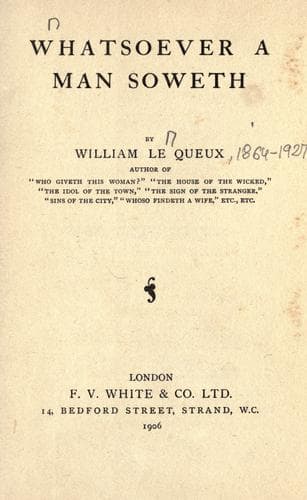
London (England) -- Fiction; Man-woman relationships -- Fiction; Mystery fiction
Half an hour later my valet returned with the information that Mr
Winsloe was out of town, and was not expected back for several days. He
had gone to the north, his man believed, but he had no instructions to
forward letters.
Gone north! Had he discovered Tibbie's whereabouts and gone after her?
Mine was a tantalising position, unable to return to my own rooms for
fear that Winsloe and Parham should discover that I was still alive.
They believed me to be dead--that I had "gone home," as "White Feather"
reported.
That night I spent several hours wandering through those streets behind
Regent Street, trying to recognise the house with the fatal stairs.
All, however, was to no purpose. I had, I think, mistaken the direction
which we had taken. Tired and worn out, I ate supper about ten o'clock
in a small and rather uncleanly little foreign restaurant in Dean
Street, and then returned to the Adelphi, where I sat a long time in my
room overlooking the Embankment and the Thames, lost in the mazes of
mystery that now presented themselves.
Where was Eric Domville? Where was Ellice Winsloe? Where was John
Parham, _alias_ Humphreys?
Tibbie evidently knew a great deal more than she would admit. She had
told me that my friend was in Paris. How could she know if she held no
communication with anyone?
No--the more I reflected the more evident did it become that she was
playing a double game.
As I sat at the window with the dark deserted gardens below me, the row
of gas-lamps and the wide river before me, I tried to analyse my real
feelings towards the dainty little love of my youth.
She was a woman guilty of the terrible crime of murder, and yet I had
promised to shield her because she had declared that her enemies
intended to crush her. Had I really acted rightly? I asked myself.
Truly, I was endeavouring to defeat the ends of justice. Nevertheless,
I recollected her wild earnest appeal to me, how she had fallen upon her
knees and implored my help and protection. I remembered, too, that in
her desperation she would have taken her own life rather than face her
enemies.
What did it all mean?
So extraordinary had been the sequence of amazing events that my mind
failed to grasp the true significance of all the facts.
Of one truth, however, I was well aware, namely, that the dull life of
workaday Camberwell had worked a wonderful change in my little friend.
She was more sedate, more composed, more womanly, while her calmness
accentuated her sweetness of manner. Yet why did she wish to pose as a
married woman? What did she fear beyond the exposure of her crime?
She was fascinating, I own that. But upon her beauty and grace was
resting that dark, gruesome shadow, the shadow of the sword of
retribution, which hung over her, and from which she, alas! would never
escape.
What did the family think of her prolonged absence? What did the police
think?
Public-domain text, read in full here on John Shaqi.
Reviews
Reviews
No reviews yet
Be the first to share your thoughts on this work.
Elsewhere in the archive
Join the Discussion
Join the discussion
Sign in to leave a comment or review.
Sign InorCreate an account