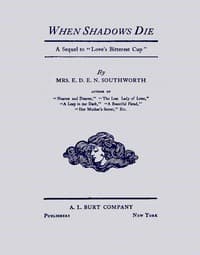
When shadows dieSouthworth, Emma Dorothy Eliza Nevitte
General
When shadows die
Southworth, Emma Dorothy Eliza Nevitte
American fiction -- 19th century
“He took my hand, bowed over it and left the room.
“Then I sat down to my desk to write the letter to Saviola in Paris.
“I did not reproach him, nor lament his absence, nor write in any way
unkindly or sorrowfully to him. I simply reminded him how long he had
been gone; how many letters I had written that remained unanswered, and
then inquired whether he meant to return to me, and if so, when? I ended
by telling him that my little son and myself were in good health, and
begging him to answer me to the point that I might know what to do. So I
left him at perfect liberty to act for himself.
“When I had sealed and directed this letter I rang and dispatched it to
the hotel bag that left the house at a quarter to eleven.
“Then I went to bed.
“My child usually slept with his nurse in a little room off my
bedchamber. But now I called her to bring the baby to me; and I took him
into bed and drew him to my bosom, finding comfort in the thought that
my child would never desert me, and that no one on earth had power to
take him from me. What a soothing balm that little form was pressed to
my heart.
“I lay awake nearly all that night, not with trouble or anxiety, but
with thoughts and plans for the future of my child and myself.
“I had made up my mind. If I should get no answer from Saviola I would
make ready and leave Switzerland for Ireland. I would go with my child
to Weirdwaste, which was my own, and live there as I had lived before
the fatal journey to Brighton. I would live among my warm-hearted Irish
tenants, who, poor as my forefathers had been for generations, had never
been oppressed, but always helped to the extent of our power. They had
loved my mother, had loved me for her sake, and they would now welcome
and love my child, who would be the heir of Weirdwaste, if of nothing
more.
“I would live at Weirdwaste until the return of my father, when I would
confess all my faults and follies to him, and appeal to his affection
for forgiveness and protection.
“In two years and a few months I should be of age, and should enter into
the full possession of my poor, old estate.
“I should live there always, and bring up my boy to be a Christian
gentleman and a good and wise landlord.
“The excellent vicar should be his tutor and look after his education,
and the amiable doctor should be his physician and look after his
health.
“Francis, my dear brother, would visit me often, I felt sure. My father
would come sometimes. These were all I really cared to see.
“We should be happy—my little son and I—in spite of all that had passed.
He would never, from his father’s example, grow up to become a gambler,
a wine bibber, or an adventurer. He should be trained to become an honor
to his name and a blessing to his tenantry.
“Thinking these pleasant thoughts I fell asleep at last and realized all
my anticipations—in my dreams!
“The next day, and every day for a week, Angus Anglesea came to see me.
Public-domain text, read in full here on John Shaqi.
Reviews
Reviews
No reviews yet
Be the first to share your thoughts on this work.
Elsewhere in the archive
Join the Discussion
Join the discussion
Sign in to leave a comment or review.
Sign InorCreate an account