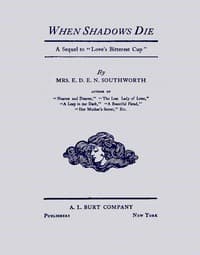
When shadows dieSouthworth, Emma Dorothy Eliza Nevitte
General
When shadows die
Southworth, Emma Dorothy Eliza Nevitte
American fiction -- 19th century
“‘I made every inquiry, but could learn no more at Weirdwaste. I went
back to Northumberland—to Enderby—and remained until after the funeral
of my dear wife. Then I went down to Brighton to make inquiries there. I
found the house where you had lodged—to which all my letters had been
directed—but the landlady could tell me nothing more than that the young
lady had been missed one day, and that at the end of the same week the
two old ladies had given up their apartments and had gone to London. And
that, subsequently, she had heard a report that the young lady had gone
off to Scotland, with “the Italian,” to be married; but she did not know
the truth of the matter.’
“‘I do not know how the report could have got out, except through my
teachers.’
“‘Of course it was through them. When I could hear no more I went up to
London to transact some business with my banker. I did not like to ask
any direct questions of him concerning you; nor did I have any strong
hope of hearing news of you in that quarter. Nevertheless, when our
accounts had been overhauled, I did venture to remark:
“‘“My daughter has not drawn on you of late, I perceive.”
“‘“Not for a year,” he said; “and that reminds me,” he continued, “that
I had a letter from her highness, last summer, inquiring your lordship’s
address—I believe it was from Geneva. I cannot lay my hands on it at
this time, but—yes, I am sure it was from Geneva.”
“‘How glad I am that I wrote that letter! The banker’s prompt reply was
the first clew I got to your whereabouts, as the banker’s news was the
first clew you got to mine.’
“‘Yes, my dear. I did not ask a question, burning as I was to hear more
of you. How could I ask that comparative stranger for information
respecting my daughter, with whose movements I should have been
perfectly familiar? I did not even know why he called you “her
highness.” I left England that same afternoon, and came as fast as steam
could bring me to Geneva. Here I am! But I do not even know the name of
your husband.’
“Again I dropped my head upon my breast. I had so much to tell him,
besides the name of my husband. But he was waiting patiently for my
reply. I gave it.”
CHAPTER XXXV
A SHOCK
“‘Prince Luigi Saviola.’
“He stared at me in surprise, in distress.
“‘Prince Luigi Saviola!’ he echoed, without withdrawing his fixed gaze
from my face.
“‘Yes, dear father,’ I answered, wondering at the emotion, or rather at
the panic, into which my words had thrown him.
“‘Oh, my poor child! Oh, my dear child! And here you have been
controlling and concealing your own great sorrow to listen to me and to
sympathize with my lighter ones. Oh, my poor Elfrida! My poor, poor
girl!’ he breathed at last, with a voice full of distress and compassion
that I felt sure he must have heard of Saviola’s Parisian marriage, and
was grieving over it more than I was for myself. I felt that I must try
to comfort him.
Public-domain text, read in full here on John Shaqi.
Reviews
Reviews
No reviews yet
Be the first to share your thoughts on this work.
Elsewhere in the archive
Join the Discussion
Join the discussion
Sign in to leave a comment or review.
Sign InorCreate an account