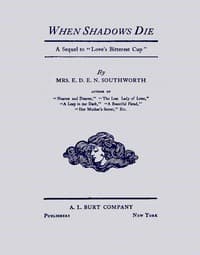
When shadows dieSouthworth, Emma Dorothy Eliza Nevitte
General
When shadows die
Southworth, Emma Dorothy Eliza Nevitte
American fiction -- 19th century
“He told me that he had not; that he had set out from the railway
station to find me first, having left all his luggage in charge of his
valet at the station. But he said that he would attend to the matter
immediately after supper, which he did.
“He succeeded in procuring rooms in the same house and in the same
corridor with me. Then he sent a messenger from the hotel to the station
to fetch his valet with the luggage.
“When these arrived he bade me good-night, and retired to his apartment.
“He had not seen my beautiful boy, nor had he asked to see him; nor had
I the courage to propose to show him.
“Now I felt a little grieved at this neglect of my innocent child.
“Early the next morning we left Geneva, and traveling as fast as steam
could carry us by land and sea, in due time we reached London. We put up
at one of the quietest hotels at the West End. Here my father insisted
that I should pay off my French maid and my Swiss nurse, and send each
back to her own country.
“When they were gone, he said:
“‘And now we take leave of the Princess Saviola forever, and we know
only Lady Elfrida Glennon.’
“‘But my boy, dear father—my boy!’ I pleaded.
“‘A proper nurse must be procured for the child without delay—some
healthy young married woman living in the country, who will take the
whole charge of the boy before we leave London. He is the child of a
deceased son of mine, and so delicate that he must be reared in the
country, and fed on fresh milk and fresh air.’
“‘And—must I part with my child, oh, father?’ I pleaded.
“‘For a time you must—for his sake as well as for your own. What should
Lady Elfrida Glennon do with a young child at Myrtle Grove?’
“I would have pleaded with him, but I saw at a glance that it was
useless to do so. Kind, tender, gentle, yielding as my father was in
most cases, yet when he once made up his mind to any course his will was
as strong as fate. Besides, I and my child were both in his power. I had
no other alternative than to obey him. And, finally, notwithstanding the
pain I felt in parting from my boy, I could not fail to see that, under
the circumstances, it was best for the child, and best for us all, that
he should be put out to be nursed.
“I took the sole charge of the child while we were seeking for a nurse.
We had many applications, but I was hard to please. At length the right
woman came; a fine, fresh, young creature, with a plump form, bright
eyes, rosy cheeks, a pleasant smile, and a sweet voice. She attracted me
at sight. She was the wife of a young dairyman. She had one child, a
week older than my boy; and she was well able to nurse twins, if Heaven
had sent twins to her. She was willing and anxious to take our little
orphan. She invited us to go down into Kent and see for ourselves the
comfort and cleanliness of the dairy farm, and the health and liveliness
of her own child.
Public-domain text, read in full here on John Shaqi.
Reviews
Reviews
No reviews yet
Be the first to share your thoughts on this work.
Elsewhere in the archive
Join the Discussion
Join the discussion
Sign in to leave a comment or review.
Sign InorCreate an account