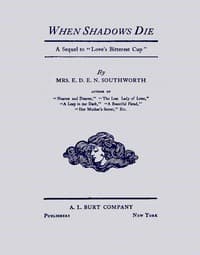
When shadows dieSouthworth, Emma Dorothy Eliza Nevitte
General
When shadows die
Southworth, Emma Dorothy Eliza Nevitte
American fiction -- 19th century
“You may wonder why I should have done this, knowing the character of
Anglesea as I did. I have sometimes wondered at the same act. But I
think it was from affection for Glennon I acted. I knew how he longed to
have Anglesea with him at Myrtle Grove. I wished to gratify that
longing. I knew that nothing I could do could either cement or sever the
bonds of that strong friendship. I knew also that Anglesea never had and
never would show his cloven foot to Glennon, or that even if he should
do so, Glennon would never tolerate it; he would fly from it. I felt
instinctively that Anglesea could never harm my brother.
“More than willingly, gladly, my father agreed to my plan. He wanted to
gratify his son. So I wrote immediately to see if I could obtain
lodgings, ‘for change of air,’ at the dairy farm. In good time came a
favorable answer.
“Then my father wrote to Glennon, authorizing him to invite his friend
to spend the Easter holidays with him at Myrtle Grove.
“I did not wait for the arrival of the visitor, but on the Wednesday
before Easter I set out alone for Kent, meaning to engage some country
girl in the neighborhood of the dairy to wait on me while in lodgings.
“I reached the dairy about four o’clock on that Wednesday afternoon, and
found my son, now a fine boy over three years old, in the rosiest health
and most boisterous spirits. He sprang into his ‘auntie’s’ arms and
covered her with caresses before he began to search her pockets and her
hand bag for the sweetmeats and toys she was accustomed to bring him.
“A dainty tea table was waiting for me in a charming cottage parlor. So
Mary Chester coaxed my ‘nephew’ from his ‘auntie’s’ arms and showed me
into a clean, neat, fresh bedroom, snow white, as all delectable
bedrooms were in the days before the ‘decoration’ craze spread over the
land. There I laid off my bonnet and washed off the railroad dust.
“And then I returned to the parlor, where my ‘nephew’ was allowed to
join me at the tea table, sitting up in a high armchair.
“That night Mary Chester waited on me as lady’s maid, but the next day I
procured the country girl I had been thinking of.
“I spent a really happy week at the dairy with my child and his
foster-brother. These two children were so fond of each other that it
was a comfort and delight to me to think of them together.
“Mary Chester had no other children, and she was entirely devoted to
them. John Chester, her husband, was a fine, wholesome, honest young
man, bearing an excellent character in the neighborhood. We all went to
the parish house together on Easter Sunday, leaving the two baby boys at
home in charge of Mary Chester’s grandmother, who was too infirm to sit
through the long church service, but who was quite equal to the care of
two children for a few hours.
“As Easter week drew to a close I began to think of returning to Myrtle
Grove.
“But I did not leave the dairy until I received a letter from my father,
informing me that the visitors had departed.
Public-domain text, read in full here on John Shaqi.
Reviews
Reviews
No reviews yet
Be the first to share your thoughts on this work.
Elsewhere in the archive
Join the Discussion
Join the discussion
Sign in to leave a comment or review.
Sign InorCreate an account