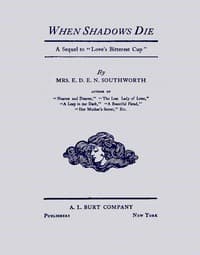
When shadows dieSouthworth, Emma Dorothy Eliza Nevitte
General
When shadows die
Southworth, Emma Dorothy Eliza Nevitte
American fiction -- 19th century
“Pardon,” said the earl; “what relation was Prince Antonio to Luigi
Saviola?”
“He was the granduncle of Luigi, who was his next of kin. When I reached
the Palazzo Saviola I was at once ushered into the presence of the
prince, who received me in his library with much cordiality. He entered
at once upon the subject in his mind by saying:
“‘You were the attendant of my grandnephew, Luigi, on the occasion of
his marriage with the only daughter of an English earl?’
“‘Yes, sir,’ I answered, a little surprised that he should know the
fact.
“‘So I was informed by a letter from my nephew soon after the
occurrence. You were also his second in the fatal duel in Paris, about a
year later, in which my nephew lost his life?’
“‘No, prince. I was not in Paris at the time of that unhappy meeting,’ I
answered.
“‘Then I have been misinformed upon that point. But there is no question
of your having been a witness to his marriage?’
“‘No question at all, prince. I was present in the interests of the
lady, taking the place of her father or brother, one of whom should have
been there to give her away.’
“‘Precisely. That is how I understood from Luigi your presence at this
Montague and Capulet marriage. I have lost sight of the widow entirely.
I last heard of her at Geneva. In a letter written to me by my unhappy
nephew on the night before his duel he told me that his wife was at the
Beau Rivage, Geneva, expecting the birth of a child; that if he should
survive the meeting of the next day he would hurry to her side. If he
should fall, he recommended her to my sympathy and compassion. This
letter found me prostrate with typhoid fever, and did not meet my eyes
for weeks after it was written. My nephew was dead and buried. His widow
had left Geneva, accompanied by her father and her infant. All my
efforts to find them proved fruitless, and at last I gave up inquiry.
Only lately have I become again interested in the subject. The reason is
this: I am very aged, near ninety. My sons and grandsons have all gone
before me to the better land. The last, Vittorio, departed some months
since. I have no heirs, unless it happens that the posthumous child of
Luigi proves to be a son and is now living. It is to ascertain this
point that I have called you here to-day.’
Public-domain text, read in full here on John Shaqi.
Reviews
Reviews
No reviews yet
Be the first to share your thoughts on this work.
Elsewhere in the archive
Join the Discussion
Join the discussion
Sign in to leave a comment or review.
Sign InorCreate an account