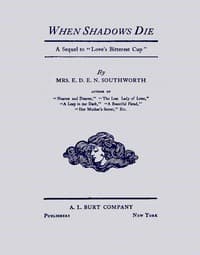
When shadows dieSouthworth, Emma Dorothy Eliza Nevitte
General
When shadows die
Southworth, Emma Dorothy Eliza Nevitte
American fiction -- 19th century
“You remember, and can now at last appreciate, the dreary loneliness and
isolation of your sister’s childhood and early youth at Weirdwaste?”
“Oh, yes! yes!”
“And the bewildering change that Brighton and a princely lover must have
been to the hitherto solitary recluse of Weirdwaste?”
“Yes, yes!”
“The fear of having to return to that desolation must have been as
strong a motive as love itself in inducing her to fly to Scotland with
her lover.”
“Most probably.”
“She had neither father, nor brother, nor any relative near her; no one
but governesses and servants.”
“Ah! my poor father never meant to be unkind, but it was cruel to leave
her in that isolation.”
“She found it so; and she listened to the pleadings of her lover, whom
her imagination had elevated into a hero, martyr, patriot and
humanitarian, when, in fact, he was only a political refugee, on account
of some hotheaded revolutionary utterances he had given.”
“Yes, I heard of Saviola’s exile while at Brighton; but I never met the
man.”
“I think your friend Anglesea had not met him at the time you were in
Brighton. He first met Saviola at Lord Middlemoor’s, on Brunswick
Terrace.”
“You seem to be well informed on all points of this affair, Force.”
“Pretty well,” said the squire; “but to proceed. Your sister went to
Scotland to marry Saviola, escorted by your friend Anglesea, who, having
done all he could to dissuade the Italian from running away with the
young lady, and having failed, was resolved that the marriage that he
could not prevent should at least be properly and legally solemnized.”
“Yes, he told us that.”
“And he told you also that he was bound to secrecy.”
“He did.”
“Well, now to the point. When the newly married pair parted from
Anglesea, on the day of their marriage, they never saw him again.”
“No?”
“No. You heard Anglesea relate how the old Prince Antonio Saviola
supposed him—Anglesea—to have acted as second to Luigi Saviola on the
occasion of his fatal duel with the Duc de Montmeri, and how
he—Anglesea—had denied all knowledge of the tragedy?”
“Yes, I did hear, and I remembered that Anglesea was at that very time
at college with me.”
“Well, then, Enderby, listen: If the bona-fide Anglesea did not
officiate as Luigi Saviola’s second in that duel, his double, Byrne
Stukely, did.”
“What!”
“Yes, Anglesea’s _bête noir_, evil genius, material counterpart, Byrne
Stukely, did. He personated Anglesea in Paris, on the dueling ground,
and at the death of Saviola, and in the apartments of Saviola’s widow!”
“Ah! what new infamy is this of which you tell me? I shall have to
prosecute that villain if he should escape the law here!” exclaimed the
earl.
“He will not escape the law here; but to proceed——”
“Yes—yes!”
Public-domain text, read in full here on John Shaqi.
Reviews
Reviews
No reviews yet
Be the first to share your thoughts on this work.
Elsewhere in the archive
Join the Discussion
Join the discussion
Sign in to leave a comment or review.
Sign InorCreate an account