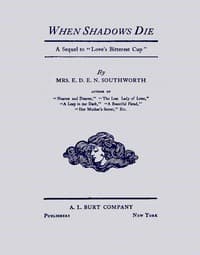
When shadows dieSouthworth, Emma Dorothy Eliza Nevitte
General
When shadows die
Southworth, Emma Dorothy Eliza Nevitte
American fiction -- 19th century
“Hush, dear, I am but an honest and well-meaning man. At least I hope I
am that much. As soon as we heard of the earl’s death I sent for the
child, whom he had cared for while he lived. The boy was brought over in
a Baltimore clipper and I went to the city to meet him. I found the boy
thriving, and I sent him down to Port Tobacco by sea while I came home
by land. I intended that he should be reared in Port Tobacco, where I
could go to see him often and watch over his training. It was a stormy
season, and I, traveling by the shorter land route, reached home fully a
week before the tempest-tossed and battered _Carrier Pigeon_ was driven
upon our shores and wrecked with the loss of all on board, except the
child alone, who was strangely saved. I should have taken him at once to
our own home but for consideration of you. I gave him in charge of Miss
Bayard. In a day or two I knew that you had seen and recognized the boy.
Then I noticed that any mention of the wrecked child distressed you. So
I did all that I could for the little lad without forcing him upon your
notice.”
“My noble Abel! I have never deserved such a heart!”
“No more of that, love. I think now that I have made ‘a clean breast of
it.’ I think I have told you all.”
“Except this: You said that my first marriage was not a fraud, but a
legal act. Oh! is that true? And if true, how came you to know it?”
inquired the lady.
“Oh, yes, I must explain that. And then, Elfrida, you must neither talk
nor listen longer. You are exhausted.”
“But tell me, first, how do you know my first marriage was legal?”
“Do you remember the discovery we made the day before you were taken
ill?—the discovery that the villain who attempted to blackmail you and
marry our heiress, under the name of Angus Anglesea, was not that
gallant officer at all, but an impostor, taking advantage of the closest
possible resemblance to Anglesea to carry out his own nefarious
purposes?”
“Yes; a relative of Anglesea—Byrne Stukely.”
“The same. Well, twenty years ago Anglesea and Stukely—I hate to connect
their names—were exact counterparts, as you have heard. Well, this same
Stukely was in Paris at the time that Saviola was there, and was taking
the name and character of his benefactor. Saviola, deceived by the name
and resemblance, mistook him for Anglesea, and asked him to act as his
second. Stukely consented, and when Saviola fell, mortally wounded, the
dying man intrusted the impostor with important papers and confidential
messages, to be delivered to you at Geneva. Now do you understand?”
“Yes, I see. But he took his time in coming to Geneva; did not make his
appearance there, indeed, until weeks after Saviola’s death, when he
came, I suppose, in the course of his own business.”
Public-domain text, read in full here on John Shaqi.
Reviews
Reviews
No reviews yet
Be the first to share your thoughts on this work.
Elsewhere in the archive
Join the Discussion
Join the discussion
Sign in to leave a comment or review.
Sign InorCreate an account