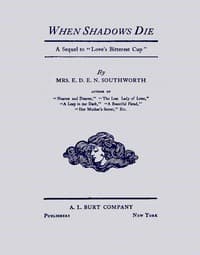
When shadows dieSouthworth, Emma Dorothy Eliza Nevitte
General
When shadows die
Southworth, Emma Dorothy Eliza Nevitte
American fiction -- 19th century
“And we are all just famishing. Here are our friends from the country,
too. They have got furnished apartments on E Street, but they have to
come here for their meals, and they are just fainting with hunger.”
The squire thought they need not have waited for him, but might have
gone down to breakfast under the escort of the old skipper, but he was
too kind-hearted to say so.
“She is only teasing you, Mr. Force. She has no respect for the fourth
commandment. We have but just arrived, and though we have excellent
appetites for our breakfast, we are not suffering from hunger,” said
Mrs. Hedge.
“I know, Wynnette,” said the chick-pecked papa. “But now we will go
downstairs at once. Where is Enderby, then?”
“He went out to breakfast with a friend who has just arrived from
England, but I didn’t catch his name,” replied the skipper.
“Oh, I know. Miss Sibby, will you take my arm?”
“Now, what do I want with your arm, Abel Force? Them as has arms and
legs of their own, sez I, don’t need to be toted along on other
people’s, sez I,” replied the old lady, trotting on before the party.
CHAPTER XLV
WINDING UP
When the party returned to the drawing room they found the earl and the
general waiting for them.
The squire greeted his friends, and then introduced the general.
The visitors from the country, who had known the counterfeit to their
cost, were now very much pleased to make the acquaintance of the genuine
officer.
Presently, taking Anglesea aside, Mr. Force said to him:
“I have had a long interview this morning with my invalid wife. There
has been a full explanation between us; but the excitement of such a
conversation has exhausted her, and nurse and doctor forbid any more
talk to-day, and enjoin absolute repose. To-morrow she will see you. In
the meantime, will you be so good, if you have no objection, to go with
Capt. Grandiere and myself to one of our military prisons? You need not
fear anything unwholesome. The place is a miracle of cleanliness.”
“A veteran of the East Indian army need not fear the sight of a military
prison,” laughed the earl. “But what may be the object of our visit?”
Mr. Force then explained the real position of Roland Bayard and of Byrne
Stukely, and the deception that had been practiced by the slaver captain
on his young prisoner to persuade the latter that he was the son of the
former, and to prevent him from giving the evidence that would clear
himself and hang his supposed father.
“It is to abuse the young fellow of this false impression, and to prove
to him his real parentage, that I wish you to accompany us to the
prison, general,” concluded Mr. Force.
“Of course, I will do all that with much pleasure. So my estimable
relative, Stukely, has wound up his career by turning pirate and slaver
in these war times! Well, something of the sort might have been expected
of him. And his extradition has been demanded by the British Government,
I hear.”
Public-domain text, read in full here on John Shaqi.
Reviews
Reviews
No reviews yet
Be the first to share your thoughts on this work.
Elsewhere in the archive
Join the Discussion
Join the discussion
Sign in to leave a comment or review.
Sign InorCreate an account