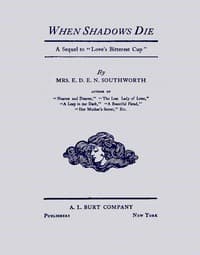
When shadows dieSouthworth, Emma Dorothy Eliza Nevitte
General
When shadows die
Southworth, Emma Dorothy Eliza Nevitte
American fiction -- 19th century
You see the matter resolved itself at length into a question of
convenience or of sentiment. And, inasmuch as it was a convention of
women who sat upon this subject, the decision may be anticipated, as
given in the favor of sentiment.
The weddings, therefore, were to be celebrated with great pomp at All
Faith Church, Mondreer and Oldfield, in St. Mary’s County—that is to
say, the double marriage ceremony was settled to be performed at All
Faith Church, the wedding breakfast to be served for both parties at
Mondreer, and the evening reception to be held at Oldfield.
After which Leonidas and Odalite would depart to spend their honeymoon
at their own little estate of Greenbushes, and Roland and Rosemary would
leave for New York en route for Europe.
The ladies had settled this quite to their satisfaction before the
gentlemen all returned with the good news that all formalities had been
duly observed, and now Roland was a free man, without the smallest
suspicion of a blemish on his honor.
“And now,” said Abel Force, “we may all go down into Maryland as soon as
we please, and show Enderby and Anglesea what our country life is like,
for they have both promised to be our guests for a season.”
“That will be delightful, and I am rejoiced to hear it,” said Mrs.
Force, very cordially. At which the two invited guests bowed.
Later on that evening, when Elfrida Force found herself alone with her
husband in their chamber, she said:
“We cannot go down to Mondreer in less than a week. I must write
to-morrow to have the house prepared for the reception of our visitors.
And while that work is going on I must do some shopping here for the two
girls. You know they cannot be married without clothes.”
“Without clothes! Good Lord, no!” exclaimed the squire, and he gave in
immediately.
The next day Mrs. Force wrote to her housekeeper at Mondreer, addressing
that worthy woman as Mrs. Anglesea, lest, with her true name on the
envelope, the missive might not reach her, or if it did, might offend
her; but—addressing her so for the last time, for after announcing the
advent of her family and visitors at Mondreer, and instructing the
housekeeper in regard to the preparations to be made for their
accommodation, Mrs. Force wrote briefly of the facts which had come to
light concerning the impostor who had called himself Col. Angus
Anglesea, but who was really Byrne Stukely, an ex-midshipman in the
royal navy, long an adventurer, and lately a pirate. She suppressed only
one fact—the existence of Stukely’s wife and family at Angleton—and this
she kept in mercy to the deceived woman, since there could be no good
come of revealing it. She ended by advising the Californian to drop the
name of Anglesea, to which the man who had given it to her had no sort
of right, and to take back that of her late husband, who had had every
claim on her love and faith. She counseled her to do this the more
especially as the real Angus Anglesea was to be one of their visitors at
Mondreer.
Public-domain text, read in full here on John Shaqi.
Reviews
Reviews
No reviews yet
Be the first to share your thoughts on this work.
Elsewhere in the archive
Join the Discussion
Join the discussion
Sign in to leave a comment or review.
Sign InorCreate an account