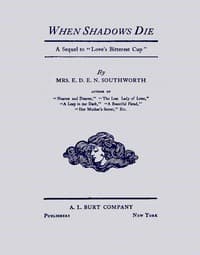
When shadows dieSouthworth, Emma Dorothy Eliza Nevitte
General
When shadows die
Southworth, Emma Dorothy Eliza Nevitte
American fiction -- 19th century
“My companion and chaperon—once my English teacher—Miss Murray, was
confined to the house by a slight attack of bronchitis, which she was
carefully nursing lest it should become serious.
“I was walking on the esplanade, attended by my French governess.
“At that early hour, ten in the morning, there were but few people out
besides nursemaids and children.
“We were sauntering along slowly, when we saw coming toward us Anglesea
and another young gentleman, walking arm in arm, apparently on the most
friendly and even affectionate terms.
“In a few minutes we met face to face.
“Anglesea bowed, and then presented his companion:
“‘Prince Luigi Saviola.’
“Madame de la Champe received the stranger’s low bow with all the
courtesy of her nation.
“I do not know how I received him, I wore a little round turban hat,
with a little thin, gray gauze mask veil over my face, which completely
shaded my features, while it enabled me to look at the stranger.
“I know not if there be any such thing as love at first sight; for the
only real, lasting love of my life was of slow growth, as you know,
Abel. Oh, Abel! you do know that I love you!
“No! I do not believe there is such a thing as real love at first sight;
but I do know that there is a madness that apes it.
“Some fascination made me look at this Italian from behind the shield of
my gray veil, while he talked with my vivacious French governess, who
quickly engaged him in conversation.
“He was young—quite youthful, indeed; and—it is a very effeminate term
to apply to a man—but he was beautiful—not handsome, but beautiful. He
was of medium height and slender proportions; but he was perfectly
elegant in form and perfectly graceful in gesture. His profile was
purely, finely Grecian. His complexion pale and clear, his hair,
eyebrows and mustache of darkest brown; his eyes of darkest violet blue.
Yet all this description gives but the outline of the youth’s form and
face—it cannot give the subtle and exquisite charm of expression which
was the chief beauty of his aspect, nor can it give the lingering music
of the most melodious voice that ever spoke.
“Are you displeased with me, that I describe this stranger so minutely?
“I do it in cold blood, Abel, and only that you may understand and
perhaps pardon the fascination he possessed over a sensitive,
imaginative young recluse, such as I had been. And some instinct told me
even then that this attraction was mutual, though we did not exchange a
word, and he could clearly see my face.
“After a few moments of courteous conversation, the two young gentlemen
bowed and walked on.
“I went home in a dream—the face and voice of the young stranger
haunting my spirit.
“The Frenchwoman made some few favorable remarks on the manner and
appearance of the young Italian; but I did not reply—I could not.
“I passed the day in a vision. I was like one possessed.
“Two days later young Anglesea made us the first call of many days.
Public-domain text, read in full here on John Shaqi.
Reviews
Reviews
No reviews yet
Be the first to share your thoughts on this work.
Elsewhere in the archive
Join the Discussion
Join the discussion
Sign in to leave a comment or review.
Sign InorCreate an account