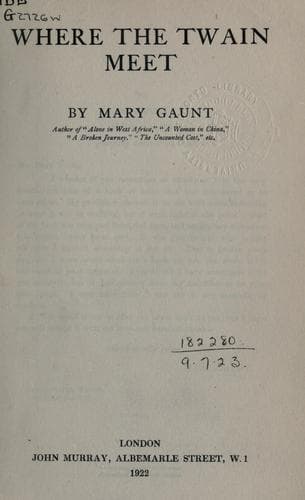
Black people -- Jamaica; Jamaica; Slavery -- Jamaica
One would think that living amidst a hostile people every white man
would be most careful in his comings and goings, careful even of what
he said, for though at first the negroes did not understand English, the
house servants soon learned it, and we may be very sure that the doings
and sayings of the people up at the Great House were reported daily in
the slave village and listened to with as great avidity as to-day we
read the news of the world in the daily papers.
Besides, all the slaves were not hostile. The Creoles, born to the
conditions in which they found themselves, were more contented. They
regarded slavery as their natural lot, and it was only by slow degrees
that the talk of emancipation grew. But it did grow and the rebellion
of 1882, a very devastating one, which ran like wildfire through
Westmoreland, Hanover, and St James', was caused mainly because at
the Great Houses and the “Buckras'” tables the white people talking
carelessly before the black servants, to whom they never gave a thought,
declared emphatically that all this talk of emancipation was so much
rubbish.
And at Christmas time, the angry, disappointed, misguided slaves rose. I
have always taken particular interest in this rebellion, because I once
enjoyed the hospitality of Montpelier, one of the loveliest pens in
Jamaica, where much money has been spent, and beneath the trees on
the green grass rest white Indian cattle bred for draught purposes. Mr
Edwards, the owner, told me that he used to hear stories in his youth
of how the slaves burned the houses, and mills, and cane pieces, and the
night was alight with blazing fires. Major Hall and his wife, high in
the hills at Kempshot, received warning just in time, and through the
darkness made their way to Worcester, lying far below.
It must have been terrible, stumbling down that stony mountain path
through the darkness, with the dread fear that the enemy might reach
Worcester before them. Neither husband nor wife returned, nor was the
house rebuilt, and not till nearly fifty years afterwards did Mr Maxwell
Hall, seeking through the country for a site on which to build an
observatory, choose a hill on Kempshot Pen just above the place where
the old house had stood. Where the country was not dense jungle it was
occupied by negro cultivators, the most destructive cultivators perhaps
in the world, of the old house there was not one stone left upon
another, nothing remained but the Mango Walk. It stands there still, the
only monument to the white people who once lived on that spot. The trees
have long given over bearing, but the avenue is a thing of beauty, and
to the very tops has grown a lovely creeper which strews the ground
beneath with heavily scented white bellshaped flowers.
Public-domain text, read in full here on John Shaqi.
Reviews
Reviews
No reviews yet
Be the first to share your thoughts on this work.
Elsewhere in the archive
Join the Discussion
Join the discussion
Sign in to leave a comment or review.
Sign InorCreate an account