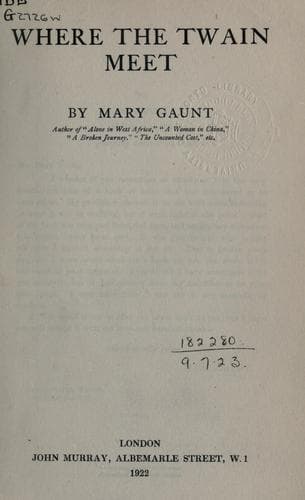
Black people -- Jamaica; Jamaica; Slavery -- Jamaica
Bryan Edwards says the Spaniards left 1500 slaves behind them. Bridges
is sure that every Spanish slave was killed or taken within eight years
of the conquest of the island. But this parson of the Church of England
is a gentleman whom the more we read him the less we like him. He was
a time-server and a sycophant on his own showing. His evident intention
was to please the planters, and though that in itself is not a crime,
it is certainly a sin, when a man undertakes to write a history, to look
only for the good on one side, and to be very sure of the evil on the
other. In the days of Bridges (he wrote in 1828), the island was divided
into planters and slaves, and the man who drank the planters' punch,
who was entertained in their houses, who laid himself out to be so
invited--“sucked up” as Australian school-boys used to say--was hardly
likely to consider the slaves anything but the dregs of humanity. It
flattered the vanity of the planters to think that within eight years of
the driving out of the Spaniards their slaves were subdued as well. It
is hardly likely they were. It seems to me that that little band of men,
hidden away among the cockpit country of St James and Trelawny, and in
the mountains of Portland and St Thomas, probably began with the
slaves left behind by the Spaniards, and were recruited by all the more
adventurous spirits who managed to escape from their loathed bondage.
For I do not believe that the black people, as some people say, were
happier as slaves. Rather do I agree with Burke who, in the great
debates on the Abolition of the Slave Trade, said: “That nothing made a
happy slave but a degraded man.”
The cockpit country of Jamaica is an amazing country still. I paid it a
visit by the courtesy of Mr Moralez, the father of the lovely girl
who owned the little canoe, and she came with me to show me points of
interest, for she had lived in Montego Bay all her life.
It was a glorious morning in December, and December mornings in Jamaica
are more likely to be delicious than a May morning in England or
Australia. There is something in the soft, cool air that no mere pen
can describe. Everywhere is green, dark green of pimento, light green
of akee or dogwood, vivid green of cane. Crushing in the sugar mills has
begun, and all is activity as you pass the works on the estates. On the
roads, marching along with loads on their heads, mostly of green banana
for it happened to be a Monday, were throngs of people, mostly women.
They tramp miles--old women, young women, boys, and little girls who
step out on sturdy little black legs and swing their short and scanty
frocks, and are smiling under a load that surprises me, for they
are proud that they, too, may join the throng of wage-earners, small
wage-earners when we compare results with other labourers in the outside
world, but still, slaves no longer, and earning money that is their very
own.
Public-domain text, read in full here on John Shaqi.
Reviews
Reviews
No reviews yet
Be the first to share your thoughts on this work.
Elsewhere in the archive
Join the Discussion
Join the discussion
Sign in to leave a comment or review.
Sign InorCreate an account