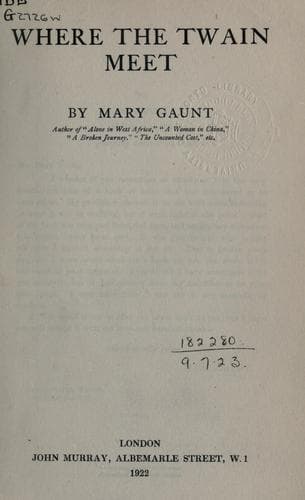
Black people -- Jamaica; Jamaica; Slavery -- Jamaica
I have lived in Trelawny and in Montego Bay, places close to the Maroon
Country, though twenty miles in Jamaica up steep acclivities, down
abrupt slopes, across mountain passes, is twenty times as far as it
would be in another land. But the Hyde was close to the cockpit country.
We went just a little way behind into the hills and we soon came to a
place where no wheeled vehicle could pass, where we must of necessity
walk along the bridle track cut in the side of the steep mountains that
rose up on either hand, though perhaps a very surefooted horse or mule
might have carried us in safety. And all the houses round about those
hills had loopholes in their walls.
“For the Maroons.”
The people have forgotten long ago the old-time fear; only when you
see a curious loophole in the lower masonry of a house, a house on
the hillside to which you mount by many winding stone steps--a fine
staircase in any land--and you ask what is that for, the dwellers say,
“The Maroons.” But sometimes it was for general defence, defence against
the picaroons that infested the seas, against the slaves who might rise
at any time. But round about Montego Bay and in the hills in Trelawny
close against the cockpit country those slots in the masonry were
certainly against the Maroons.
Dallas says that many of the slaves who rose at Suttons in Clarendon
made their way to the Maroons in the heart of the island, and after
that their numbers were occasionally recruited from among the plantation
negroes. They got provisions from the provision grounds, and the
settlers who lived a little back from the towns in places like Balaclava
(which was not Balaclava then), Ulster Springs, on the mountain sides
as at the Hyde, Catadupa, and quaintly named Lapland, were kept in a
perpetual state of alarm.
There was a time when I thought to be kept in a perpetual state of alarm
would make life impossible, and I wondered at pioneers who first crossed
Kentucky--“that dark and bloody ground,”--at the estate owners and
pen-keepers who dwelt among their discontented slaves in places where
the Maroons might easily raid; indeed I wonder still. But now, in a
measure I understand. During the war I lived not far from Woolwich
arsenal, that magnet for German airships. Were people there afraid?
Public-domain text, read in full here on John Shaqi.
Reviews
Reviews
No reviews yet
Be the first to share your thoughts on this work.
Elsewhere in the archive
Join the Discussion
Join the discussion
Sign in to leave a comment or review.
Sign InorCreate an account