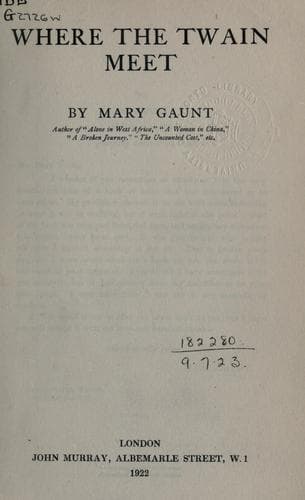
Black people -- Jamaica; Jamaica; Slavery -- Jamaica
It had been impressed upon him that he courted death if he drank
orangeade, if he walked in the morning after ten or went out in the cool
of the evening, “be exposed to the dews after sundown” they put it.
But he dares to write: “The air too was delicious, the fragrance of
the sweetwood and other scented trees, but above all of the delicious
logwood of which most of the fences in Westmoreland are made, composed
an atmosphere such that if Satan after promising them a buxom air
embalmed with odours, had transported Sin and Death thither the charming
people must acknowledge their papa's promise fulfilled.” It reads
quaintly now. Sin--sin is so much a matter of the standard we set up.
If the slave had copied the planter, no master would have considered him
anything but a very sinful slave; and death--death is often very, very
kindly.
Lewis enquires into the condition of the people. His attorney had
written to him regularly of the care he expended on the negroes, but he
had been away much of his time managing other estates, and had delegated
his authority to an overseer who treated the people so harshly that
at last they left the estate in a body and threw themselves on the
protection of the magistrate at Savanna-la-Mar, “and if I had not come
myself to Jamaica, in all probability I should never have had the most
distant idea how abominably the poor creatures had been ill-used.”
Now this marks a distinct advance since the times when the savages,
speaking a jargon no one cared to understand, were driven to work with a
whip.
Lewis, to the intense surprise of his compeers, objected to the use of
the whip.
“I am, indeed, assured by everyone about me, that to manage a West
Indian estate without the occasional use of a cart whip, however rarely,
is impossible; and they insist upon it that it is absurd in me to call
my slaves ill-treated, because when they act grossly wrong they are
treated like English soldiers and sailors. All this may be very true;
but there is something to me so shocking in the idea of this execrable
cart whip that I have positively forbidden the use of it on Cornwall;
and if the estate must go to rack and ruin without it, to rack and ruin
the estate must go.”
But, of course, all men were not as broadminded as Lewis. Bridges, who
wrote twelve years later, could never mention a negro without adding
some disparaging adjective, “the vigilance which African perfidy
requires.”
“Experience proves that a strange uniformity of barbarism pervades them
all; and that the only difference lies in the degrees of the same base
qualities which mark the negro race throughout.”
“The salutary measures were of little avail in winning over by
indulgence, or restraining by terror the impracticable savages of
Africa.” Such are a few of the gems dispersed through his work. He
could see no good in a black man, except that his thews and sinews were
necessary to the development of the country, and he grudged them even
that measure of praise.
Public-domain text, read in full here on John Shaqi.
Reviews
Reviews
No reviews yet
Be the first to share your thoughts on this work.
Elsewhere in the archive
Join the Discussion
Join the discussion
Sign in to leave a comment or review.
Sign InorCreate an account