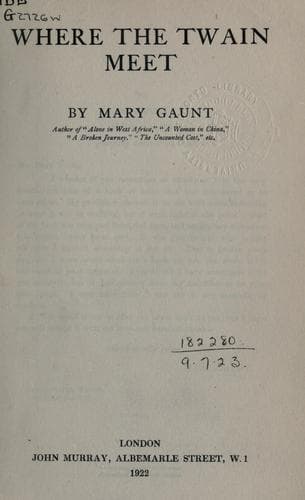
Black people -- Jamaica; Jamaica; Slavery -- Jamaica
“In my drive this morning met several of the unfortunate half black
progeny of some of our staff,” writes Lady Nugent, “all in fine muslin
lace, &c., with wreaths of flowers in their hats. What ruin for these
worse than thoughtless, young men.” If she wrote thus, she probably
did not refrain from comment at the time, and doubtless her comment was
resented.
“Soon after my arrival,” writes Matthew Lewis, “I asked my attorney” (an
attorney in Jamaica is the man who manages the estate for an absentee
owner) “whether a clever-looking woman who seemed to have great
authority in the house belonged to me.”
“'No, she was a free woman.'
“'Was she in my service then?'
“'No, she was not in my service; I began to grow impatient.
“'But what does she do at Cornwall? Of what use is she in the house?'
“'Why, sir, as to use, of great use, sir'; and then, after a pause,
added in a lower voice, 'It is the custom, sir, for unmarried men to
have housekeepers, and Nancy is mine.'”
Lewis wrote in the second decade of the nineteenth century a little
after Lady Nugent, and putting all these little stories together, we get
a complete picture of the Jamaican estate as it must have been for close
on two hundred years.
The black people, naked at first and later clad in rags, lived in a
little village some distance from the Great House where dwelt their
master, and the bond between them was the woman he took from amongst
them for his convenience. The villages were of palm-thatched houses with
walls of swish or of wattle, and were very often surrounded by a wall,
for if the owner valued his privacy so did the dweller in the village,
and presently around them grew up a grove of trees planted by the negro
sometimes by design, sometimes by accident; there were coconut palms and
naseberries, tall leafy trees, and by the beginning of the nineteenth
century, thanks to Bligh and Marshall, breadfruit and mango trees, the
handsomest trees, perhaps, that bear fruit, and there were oranges and
lemons with their fragrant blossoms.
Public-domain text, read in full here on John Shaqi.
Reviews
Reviews
No reviews yet
Be the first to share your thoughts on this work.
Elsewhere in the archive
Join the Discussion
Join the discussion
Sign in to leave a comment or review.
Sign InorCreate an account