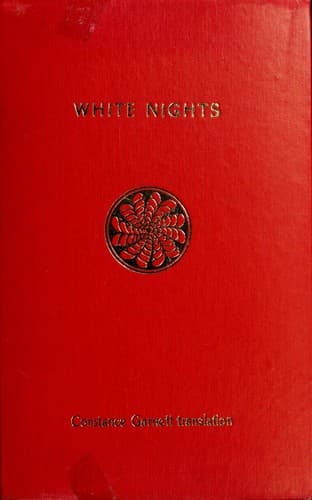
White nights, and other storiesDostoyevsky, Fyodor
General
White nights, and other stories
Dostoyevsky, Fyodor
Dostoyevsky, Fyodor, 1821-1881 -- Translations into English; Russian fiction -- Translations into English
It was a good thing, in fact, that Apollon distracted my attention at
that time by his rudeness. He drove me beyond all patience! He was the
bane of my life, the curse laid upon me by Providence. We had been
squabbling continually for years, and I hated him. My God, how I hated
him! I believe I had never hated any one in my life as I hated him,
especially at some moments. He was an elderly, dignified man, who worked
part of his time as a tailor. But for some unknown reason he despised me
beyond all measure, and looked down upon me insufferably. Though,
indeed, he looked down upon every one. Simply to glance at that flaxen,
smoothly brushed head, at the tuft of hair he combed up on his forehead
and oiled with sunflower oil, at that dignified mouth, compressed into
the shape of the letter V, made one feel one was confronting a man who
never doubted of himself. He was a pedant, to the most extreme point,
the greatest pedant I had met on earth, and with that had a vanity only
befitting Alexander of Macedon. He was in love with every button on his
coat, every nail on his fingers--absolutely in love with them, and he
looked it! In his behaviour to me he was a perfect tyrant, he spoke very
little to me, and if he chanced to glance at me he gave me a firm,
majestically self-confident and invariably ironical look that drove me
sometimes to fury. He did his work with the air of doing me the greatest
favour. Though he did scarcely anything for me, and did not, indeed,
consider himself bound to do anything. There could be no doubt that he
looked upon me as the greatest fool on earth, and that "he did not get
rid of me" was simply that he could get wages from me every month. He
consented to do nothing for me for seven roubles a month. Many sins
should be forgiven me for what I suffered from him. My hatred reached
such a point that sometimes his very step almost threw me into
convulsions. What I loathed particularly was his lisp. His tongue must
have been a little too long or something of that sort, for he
continually lisped, and seemed to be very proud of it, imagining that it
greatly added to his dignity. He spoke in a slow, measured tone, with
his hands behind his back and his eyes fixed on the ground. He maddened
me particularly when he read aloud the psalms to himself behind his
partition. Many a battle I waged over that reading! But he was awfully
fond of reading aloud in the evenings, in a slow, even, sing-song voice,
as though over the dead. It is interesting that that is how he has
ended: he hires himself out to read the psalms over the dead, and at the
same time he kills rats and makes blacking. But at that time I could not
get rid of him, it was as though he were chemically combined with my
existence. Besides, nothing would have induced him to consent to leave
me. I could not live in furnished lodgings: my lodging was my private
solitude, my shell, my cave, in which I concealed myself from all
Public-domain text, read in full here on John Shaqi.
Reviews
Reviews
No reviews yet
Be the first to share your thoughts on this work.
Elsewhere in the archive
Join the Discussion
Join the discussion
Sign in to leave a comment or review.
Sign InorCreate an account