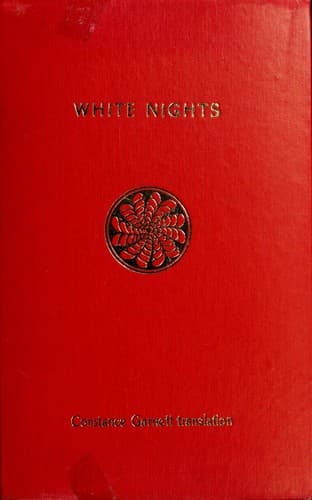
White nights, and other storiesDostoyevsky, Fyodor
General
White nights, and other stories
Dostoyevsky, Fyodor
Dostoyevsky, Fyodor, 1821-1881 -- Translations into English; Russian fiction -- Translations into English
At ten o'clock Mme. M.'s husband arrived. Till that moment I watched her
very attentively, never taking my eyes off her mournful face; now at the
unexpected entrance of her husband I saw her start, and her pale face
turned suddenly as white as a handkerchief. It was so noticeable that
other people observed it. I overheard a fragmentary conversation from
which I guessed that Mme. M. was not quite happy; they said her husband
was as jealous as an Arab, not from love, but from vanity. He was before
all things a European, a modern man, who sampled the newest ideas and
prided himself upon them. In appearance he was a tall, dark-haired,
particularly thick-set man, with European whiskers, with a
self-satisfied, red face, with teeth white as sugar, and with an
irreproachably gentlemanly deportment. He was called a _clever man_.
Such is the name given in certain circles to a peculiar species of
mankind which grows fat at other people's expense, which does absolutely
nothing and has no desire to do anything, and whose heart has turned
into a lump of fat from everlasting slothfulness and idleness. You
continually hear from such men that there is nothing they can do owing
to certain very complicated and hostile circumstances, which "thwart
their genius," and that it was "sad to see the waste of their talents."
This is a fine phrase of theirs, their _mot d'ordre_, their watchword, a
phrase which these well-fed, fat friends of ours bring out at every
minute, so that it has long ago bored us as an arrant Tartuffism, an
empty form of words. Some, however, of these amusing creatures, who
cannot succeed in finding anything to do--though, indeed, they never
seek it--try to make every one believe that they have not a lump of fat
for a heart, but on the contrary, something _very deep_, though what
precisely the greatest surgeon would hardly venture to decide--from
civility, of course. These gentlemen make their way in the world through
the fact that all their instincts are bent in the direction of coarse
sneering, short-sighted censure and immense conceit. Since they have
nothing else to do but note and emphasize the mistakes and weaknesses of
others, and as they have precisely as much good feeling as an oyster, it
is not difficult for them with such powers of self-preservation to get
on with people fairly successfully. They pride themselves extremely upon
that. They are, for instance, as good as persuaded that almost the whole
world owes them something; that it is theirs, like an oyster which they
keep in reserve; that all are fools except themselves; that every one is
like an orange or a sponge, which they will squeeze as soon as they want
the juice; that they are the masters everywhere, and that all this
acceptable state of affairs is solely due to the fact that they are
people of so much intellect and character. In their measureless conceit
they do not admit any defects in themselves, they are like that species
Public-domain text, read in full here on John Shaqi.
Reviews
Reviews
No reviews yet
Be the first to share your thoughts on this work.
Elsewhere in the archive
Join the Discussion
Join the discussion
Sign in to leave a comment or review.
Sign InorCreate an account