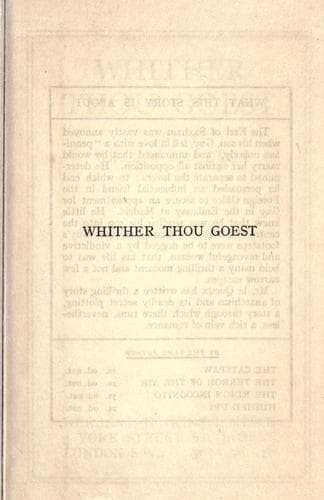
Adventure stories; Anarchists -- Fiction; British -- Spain -- Fiction; Madrid (Spain) -- Fiction
He was only away a very short time, but Moreno's nerves were on the rack
during the brief absence. Were his suspicions going to be absolutely
confirmed, or still left in the region of mere conjecture?
The grey-haired man came back, and placed half a dozen closely covered
sheets before him. They were in a small, clear, feminine handwriting.
Triumph glared in Moreno's dark eyes. "As I guessed. She wasn't clever
enough to disguise her hand. I can understand she could not run the
risk of having them copied. Why didn't she get Rossett to write them
out at her dictation?"
The other man made no reply to this ebullition on the part of the young
Spaniard.
"Of course you can't part with these, or any one page of them?" asked
Moreno.
"Out of the question," came the expected answer. "I quite agree. But
you can get photographs taken of them, and then I shall have this woman
in the hollow of my hand."
"That shall be done, Mr Moreno. You are going back to Spain to-day.
They shall be sent to you to-morrow at whatever address you leave with
me." And Moreno walked out of the cosy little room well pleased with
himself. Guy Rossett might have saved him all this trouble if he had
chosen to open his mouth. Still, he had got the information he wanted.
And, above all, what a fool Violet Hargrave had been, to let those
memoranda go out in her own handwriting! Moreno, who thought of every
detail, would not have done that.
CHAPTER THIRTEEN.
The great anarchical association of which Ferdinand Contraras was the
leading spirit did not differ greatly in essential features from those
tyrannical and effete institutions which it was striving to supersede.
There was still the wide gulf between the classes, bridged over
speciously by the fact that they addressed each other as "comrade,"
waiving all distinctive titles.
The chief addressed the educated young fisherman as Somoza shortly,
which was natural. And, on the other hand, Somoza addressed him, though
always very respectfully, as Contraras, which would not have been at all
natural, under ordinary circumstances.
Still, Somoza did not slap him on the back, or take liberties, as he
would have done with an elderly fisherman in his own rank of life. The
gulf of class could not quite be crossed by dropping titles, and calling
each other comrade.
And then there was the question of wealth. Contraras, in spite of his
numerous donations to the cause, was still rich; so was Jaques.
Zorrilta was moderately well-off. Alvedero and Lucue were poor. The
sharing out had not begun yet. Lucue, as we know, lived in humble
lodgings in Soho, which galled him somewhat, as he was fond of comfort
and the flesh-pots.
Contraras, after a brief sojourn at Fonterrabia had come back to Madrid,
where he had many friends in his own sphere of life. Although not of
noble birth himself, he had married a woman, a member of a family poor
but boasting of the proudest blood of Spain in its veins.
Public-domain text, read in full here on John Shaqi.
Reviews
Reviews
No reviews yet
Be the first to share your thoughts on this work.
Elsewhere in the archive
Join the Discussion
Join the discussion
Sign in to leave a comment or review.
Sign InorCreate an account