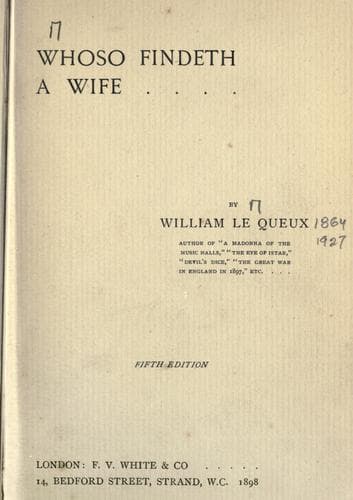
England -- Fiction; Political fiction; Politicians -- Fiction; Spy stories
"The situation is becoming absolutely bewildering," observed the
Premier. "It may be best, I think, to convene another meeting of the
Cabinet."
Lord Warnham, with that involuntary caution that he had developed during
long years of office as Minister of Foreign Affairs, at once dismissed
Frank Lawley, but allowed me to remain. As his confidential secretary I
had been present on many occasions when delicate matters of diplomacy
had been adjusted and plans arranged which, if divulged, would have
caused an upheaval throughout Europe.
"No, I don't think another Council is necessary, at least not to-night,"
answered Lord Warnham, when the cosmopolitan messenger had closed the
door behind him.
"But the whole thing is at present a mystery," said the Prime Minister,
standing astride with his broad back to the empty grate.
"Exactly. We must have news from the Embassy in St Petersburg before
long. Until then, I think we should be patient."
"But hark!" exclaimed the Premier, quite calmly, and as we all three
listened we could hear the dull roar of the crowd becoming louder. The
popular excitement outside was intense, and the eager multitude
increased each moment. "They are clamouring for news. It is, I think,
time that another statement should be made in the House."
"As you wish," Lord Warnham answered, with ill grace. It was part of
his creed to tell the public absolutely nothing. The Premier was for
publicity--he for secrecy always.
"But whatever statement is made regarding the receipt of intelligence it
cannot compromise our position at St Petersburg," the Marquis argued.
"Very well. Let the statement be made. But, personally, I cannot see
what we can say at present."
"Say something. It will reassure the public that we are endeavouring to
readjust diplomatic negotiations. Already we are being hounded down on
all sides by wild-haired agitators as having been asleep. Let us show
our opponents that we are now fully alive to England's peril."
"Ah, Maybury," laughed the Foreign Minister, "it is always my opinion
that the less the public know the easier it is for us to carry on the
business of the country. The irresponsible journals are really the
cause of nine-tenths of our diplomatic ruptures."
"But the Press assist us in many ways, and if you are averse to a
statement in the House why not make one to _The Times_, or to a news
agency? Perhaps the latter course would be best, for it will
re-establish public confidence."
"But that will not be official," Lord Warnham demurred.
"Nevertheless, we can make the official statement later, when we have
received confirmation of this extraordinary dispatch."
"Is the dispatch from Paris very remarkable?" I asked, unable to any
longer bear their tantalising conversation, so anxious was I to
ascertain the latest development of this conspiracy against our country.
Public-domain text, read in full here on John Shaqi.
Reviews
Reviews
No reviews yet
Be the first to share your thoughts on this work.
Elsewhere in the archive
Join the Discussion
Join the discussion
Sign in to leave a comment or review.
Sign InorCreate an account