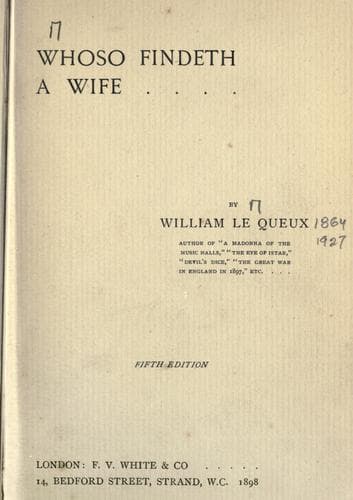
England -- Fiction; Political fiction; Politicians -- Fiction; Spy stories
Thus a month went by. Lord Warnham had slightly relaxed towards me as
if, after all, he believed that I had spoken the truth, although he
frequently, when vexed, would refer in uncomplimentary terms to what he
called my "carelessness that nearly cost England her honour." Indeed,
although I had been reinstalled in the position of great trust I had
previously held, mine was no enviable lot. The Foreign Minister was a
man of moods, strangely eccentric, sometimes preserving a rigid silence
for hours, and often working for long periods alone during the night,
attending to unimportant dispatches that might have been answered by a
lower-grade clerk. But it was his object always to know the exact work
done in each department, and to be able to do it himself. Thus he was
enabled to keep a more careful watch over everything that went on, and
was not, like the majority of Cabinet Ministers, a mere figure-head.
Times without number I have gone to Berkeley Square early in the morning
when some important matter of diplomacy has been in progress, and found
the grey, thin-faced peer still seated in his study, the blinds still
down, the electric light still on, showing how he had worked on
unconsciously throughout the whole night, and was quite unaware of dawn.
His servants had strict orders never to disturb him, even for meals,
hence, when he was busy, he frequently spent many hours in his chair,
regardless of day or night.
These periods of intense mental strain would, however, be followed by
exasperating irritability of such a character that I often feared to
utter a word lest he should break out into a fierce ebullition of anger.
At those times he would scatter broadcast the most severe censures on
all and sundry, sparing neither ambassador nor consul, so fierce was his
wrath. Knowing this, I would sometimes, after writing an abusive
dispatch at his dictation, put it aside and, instead of forwarding it,
accidentally overlook it. Then, next day, he would almost invariably
relent, and after deep thought, exclaim,--
"Read me the copy of that dispatch I sent yesterday to Vienna, Deedes."
"Oh," I would answer, as if suddenly recollecting, "I quite forgot to
forward it, we were so busy yesterday."
"Ah, too late now! too late!" he would grumble, feigning annoyance, yet
secretly pleased. "Destroy it, Deedes; destroy it."
Afterwards he would dictate a more temperate and less offensive letter,
which the messenger leaving London that night would carry in his valise.
Public-domain text, read in full here on John Shaqi.
Reviews
Reviews
No reviews yet
Be the first to share your thoughts on this work.
Elsewhere in the archive
Join the Discussion
Join the discussion
Sign in to leave a comment or review.
Sign InorCreate an account