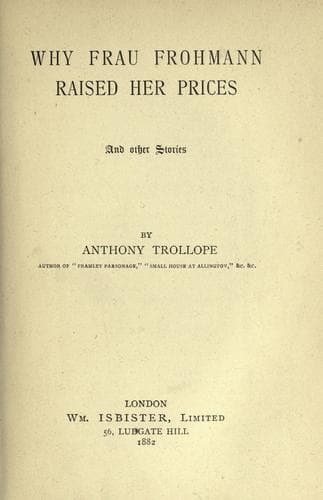
Why Frau Frohmann Raised Her Prices, and Other StoriesTrollope, Anthony
General
Why Frau Frohmann Raised Her Prices, and Other Stories
Trollope, Anthony
English fiction -- 19th century; Manners and customs -- Fiction; Short stories, English
She had not had her way. She remembered that at the moment. But then,
perhaps, the major-general had had his. When a period of life has come
too late for success, when all has been failure, the expanding triumphs
of the glorious young, grate upon the feelings even of those who are
generous and self-denying. Miss Gregory was generous by nature and
self-denying by practice, but Philip’s pæan and Bessy’s wondrous
prosperity were for a moment a little hard upon her. There had been a
comfort to her in the conviction that Philip was no better than the
major-general. “I suppose it is so,” she said. “That is, if one of them
has means.”
“Exactly.”
“But if they are both poor, I don’t see how their being young can enable
them to live upon nothing.” She intended to imply that Philip probably
would have been another major-general, but that he was heir to Launay.
Philip, who had never heard of the major-general, was a little puzzled;
nevertheless, he acceded to the proposition, not caring, however, to say
anything as to his own circumstances on so very short an acquaintance.
Then Bessy came down with her hat, and they started for their walk. “Now
tell me all about it,” she said, in a fever of expectation, as soon as
the front door was closed behind them.
“There is nothing more to tell,” said he.
“Nothing more?”
“Unless you want me to say that I love you.”
“Of course I do.”
“Well, then,--I love you. There!”
“Philip, you are not half nice to me.”
“Not after coming all the way from Launay to say that?”
“There must be so much to tell me? Why has my aunt sent for me?”
“Because she wants you.”
“And why has she sent you?”
“Because I want you too.”
“But does she want me?”
“Certainly she does.”
“For you?” If he could say this, then everything would have been said.
If he could say this truly, then everything would have been done
necessary for the perfection of her happiness. “Oh, Philip, do tell me.
It is so strange that she should send for me! Do you know what she said
to me in her last letter? It was not a letter. It was only a word. She
said that I was her enemy.”
“All that is changed.”
“She will be glad to have me again?”
“Very glad. I fancy that she has been miserable without you.”
“I shall be as glad to be with her again, Philip. You do not know how I
love her. Think of all she has done for me!”
“She has done something now that I hope will beat everything else.”
“What has she done?”
“She has consented that you and I shall be man and wife. Isn’t that more
than all the rest?”
“But has she? Oh, Philip, has she really done that?”
Public-domain text, read in full here on John Shaqi.
Reviews
Reviews
No reviews yet
Be the first to share your thoughts on this work.
Elsewhere in the archive
Join the Discussion
Join the discussion
Sign in to leave a comment or review.
Sign InorCreate an account