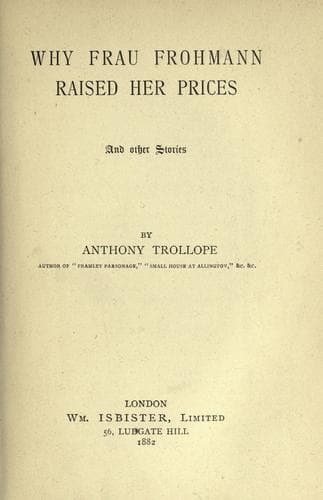
Why Frau Frohmann Raised Her Prices, and Other StoriesTrollope, Anthony
General
Why Frau Frohmann Raised Her Prices, and Other Stories
Trollope, Anthony
English fiction -- 19th century; Manners and customs -- Fiction; Short stories, English
“Of course I’ll go,” said she. “I don’t mind going in the least. Nobody
will bite me,” and she at once began to fold a clean handkerchief. “I
won’t be two minutes, my darling, and if there is a grain of mustard in
the house I’ll have it on your chest immediately.” She was a woman not
easily cowed, and the journey down into the salon was nothing to her.
Before she went she tucked the clothes carefully up to his ears, and
then she started.
To run along the first corridor till she came to a flight of stairs was
easy enough, and easy enough to descend them. Then there was another
corridor, and another flight, and a third corridor, and a third flight,
and she began to think that she was wrong. She found herself in a part
of the hotel which she had not hitherto visited, and soon discovered by
looking through an open door or two that she had found her way among a
set of private sitting-rooms which she had not seen before. Then she
tried to make her way back, up the same stairs and through the same
passages, so that she might start again. She was beginning to think that
she had lost herself altogether, and that she would be able to find
neither the salon nor her bedroom, when she happily met the
night-porter. She was dressed in a loose white dressing-gown, with a
white net over her loose hair, and with white worsted slippers. I ought
perhaps to have described her personal appearance sooner. She was a
large woman, with a commanding bust, thought by some to be handsome,
after the manner of Juno. But with strangers there was a certain
severity of manner about her,--a fortification, as it were, of her
virtue against all possible attacks,--a declared determination to
maintain, at all points, the beautiful character of a British matron,
which, much as it had been appreciated at Thompson Hall, had met with
some ill-natured criticism among French men and women. At Pau she had
been called La Fière Anglaise. The name had reached her own ears and
those of her husband. He had been much annoyed, but she had taken it in
good part,--had, indeed, been somewhat proud of the title,--and had
endeavoured to live up to it. With her husband she could, on occasion,
be soft, but she was of opinion that with other men a British matron
should be stern. She was now greatly in want of assistance; but,
nevertheless, when she met the porter she remembered her character. “I
have lost my way wandering through these horrid passages,” she said, in
her severest tone. This was in answer to some question from him,--some
question to which her reply was given very slowly. Then when he asked
where Madame wished to go, she paused, again thinking what destination
she would announce. No doubt the man could take her back to her bedroom,
but if so, the mustard must be renounced, and with the mustard, as she
now feared, all hope of reaching Thompson Hall on Christmas Eve. But
she, though she was in many respects a brave woman, did not dare to tell
Public-domain text, read in full here on John Shaqi.
Reviews
Reviews
No reviews yet
Be the first to share your thoughts on this work.
Elsewhere in the archive
Join the Discussion
Join the discussion
Sign in to leave a comment or review.
Sign InorCreate an account