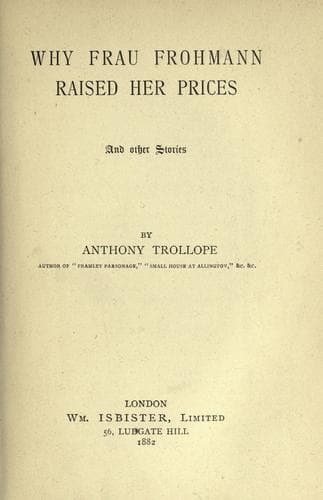
Why Frau Frohmann Raised Her Prices, and Other StoriesTrollope, Anthony
General
Why Frau Frohmann Raised Her Prices, and Other Stories
Trollope, Anthony
English fiction -- 19th century; Manners and customs -- Fiction; Short stories, English
“I do get so tired at that nasty office. Though of course I like what I
am doing now better than the other. It was that rolling up the bands
that used to kill me. But I don’t think I shall ever really be strong
till I get away from the telegraphs. I suppose you have no young ladies
where you are?”
“There are I believe a lot of them in the building, stitching bindings;
but I never see them.”
“I don’t think you care much for young ladies, Mr. Hall.”
“Not much--now.”
“Why not now? What does that mean?”
“I dare say I never told you or Miss Graham before. But I had a wife of
my own for a time.”
“A wife! You!”
“Yes indeed. But she did not stay with me long. She left me before we
had been a year married.”
“Left you!”
“She died,” he said, correcting very quickly the false impression which
his words had been calculated to make.
“Dear me! Died before a year was out. How sad!”
“It was very sad.”
“And you had no,--no,--no baby, Mr. Hall?”
“I wish she had had none, because then she would have been still living.
Yes, I have a boy. Poor little mortal! It is two years old I think
to-day.”
“I should so like to see him. A little boy! Do bring him some day, Mr.
Hall.” Then the father explained that the child was in the country, down
in Hertfordshire; but nevertheless he promised that he would some day
bring him up to town and show him to his new friends.
Surely having once been married and having a child he must want another
wife! And yet how little apt he was to say or do any of those things by
saying and doing which men are supposed to express their desire in that
direction! He was very slow at making love;--so slow that Sophy hardly
found herself able to make use of her own little experiences with him.
Alec Murray, who, however, in the way of a husband was not worth
thinking of, had a great deal more to say for himself. She could put on
her ribbons for Mr. Hall, and wait for him in the street, and look up
into his face, and call him Mr. Hall;--but she could not tell him how
dearly she would love that little boy and what an excellent mother she
would be to him, unless he gave her some encouragement.
When Lucy heard that he had been a married man and that he had a child
she was gratified, though she knew not why. “Yes, I should like to see
him of course,” she said, speaking of the boy. “A child, if you have not
the responsibility of taking care of it, is always nice.”
“I should so like to take care of it.”
“I should not like to ask him to bring the boy up out of the country.”
She paused a moment, and then added, “He is just the man whom I should
have thought would have married, and just the man to be made very
serious by the grief of such a loss. I am coming to think it does a
person good to have to bear troubles.”
“You would not say that if you always felt as sick as I do after your
day’s work.”
Public-domain text, read in full here on John Shaqi.
Reviews
Reviews
No reviews yet
Be the first to share your thoughts on this work.
Elsewhere in the archive
Join the Discussion
Join the discussion
Sign in to leave a comment or review.
Sign InorCreate an account