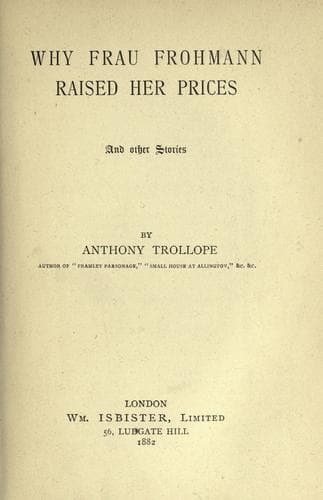
Why Frau Frohmann Raised Her Prices, and Other StoriesTrollope, Anthony
General
Why Frau Frohmann Raised Her Prices, and Other Stories
Trollope, Anthony
English fiction -- 19th century; Manners and customs -- Fiction; Short stories, English
But during these two months Sophy had been away from her office more
than half the time. Then the doctor said she had better leave town for
awhile. It was September, and it was desired that she should pass that
month at Hastings. Now it should be explained that in such emergencies
as this the department has provided a most kindly aid for young women.
Some five or six at a time are sent out for a month to Hastings or to
Brighton, and are employed in the telegraph offices in those towns.
Their railway fares are paid for them, and a small extra allowance is
made to them to enable them to live away from their homes. The privilege
is too generally sought to be always at the command of her who wants it;
nor is it accorded except on the doctor’s certificate. But in the
September Sophy Wilson was sent down to Hastings.
In spite, however, of the official benevolence which greatly lightened
the special burden which illness must always bring on those who have to
earn their bread, and which in Sophy Wilson’s case had done so much for
her, nevertheless the weight of the misfortune fell heavily on poor
Lucy. Some little struggle had to be made as to clothes before the girl
could be sent away from her home; and, though the sick one was enabled
to support herself at Hastings, the cost of the London lodgings which
should have been divided fell entirely upon Lucy. Then at the end of the
month there came worse tidings. The doctor at Hastings declared that the
girl was unfit to go back to her work,--was, indeed, altogether unfit
for such effort as eight hours’ continued attendance required from her.
She wanted at any rate some period of perfect rest, and therefore she
remained down at the seaside without the extra allowance which was so
much needed for her maintenance.
Then the struggle became very severe with Lucy,--so severe that she
began to doubt whether she could long endure it. Sophy had her two
shillings a day, the two-thirds of her wages, but she could not subsist
on that. Something had to be sent to her in addition, and this something
could only come from Lucy’s wages. So at least it was at first. In order
to avoid debt she gave up her more comfortable room and went upstairs
into a little garret. And she denied herself her accustomed dinner at
the office, contenting herself with bread and cheese,--or often simply
with bread,--which she could take in her pocket. And she washed her own
clothes and mended even her own boots, so that still she might send a
part of her earnings to the sick one.
“Is she better?” Abraham asked her one day.
“It is hard to know, Mr. Hall. She writes just as she feels at the
moment. I am afraid she fears to return to the office.”
“Perhaps it does not suit her.”
“I suppose not. She thinks some other kind of life would be better for
her. I dare say it would.”
“Could I do anything?” asked the man very slowly.
Public-domain text, read in full here on John Shaqi.
Reviews
Reviews
No reviews yet
Be the first to share your thoughts on this work.
Elsewhere in the archive
Join the Discussion
Join the discussion
Sign in to leave a comment or review.
Sign InorCreate an account