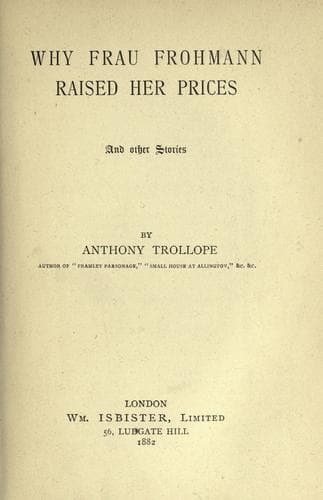
Why Frau Frohmann Raised Her Prices, and Other StoriesTrollope, Anthony
General
Why Frau Frohmann Raised Her Prices, and Other Stories
Trollope, Anthony
English fiction -- 19th century; Manners and customs -- Fiction; Short stories, English
One day, about three o’clock in the afternoon, Abraham Hall went to the
Post Office, and, having inquired among the messengers, made his way up
to the telegraph department at the top of the building. There he asked
for Miss Graham, and was told by the doorkeeper that the young ladies
were not allowed to receive visitors during office hours. He persisted,
however, explaining that he had no wish to go into the room, but that it
was a matter of importance, and that he was very anxious that Miss
Graham should be asked to come out to him. Now it is a rule that the
staff of the department who are engaged in sending and receiving
messages, the privacy of which may be of vital importance, should be
kept during the hours of work as free as possible from communication
with the public. It is not that either the girls or the young men would
be prone to tell the words which they had been the means of passing on
to their destination, but that it might be worth the while of some
sinner to offer great temptation, and that the power of offering it
should be lessened as much as possible. Therefore, when Abraham Hall
pressed his request the doorkeeper told him that it was quite
impossible.
“Do you mean to say that if it were an affair of life and death she
could not be called out?” Abraham asked in that voice which had
sometimes seemed to Lucy to be so impressive. “She is not a prisoner!”
“I don’t know as to that,” replied the man; “you would have to see the
superintendent, I suppose.”
“Then let me see the superintendent.” And at last he did succeed in
seeing some one whom he so convinced of the importance of his message as
to bring Lucy to the door.
“Miss Graham,” he said, when they were at the top of the stairs, and so
far alone that no one else could hear him, “I want you to come out with
me for half an hour.”
“I don’t think I can. They won’t let me.”
“Yes they will. I have to say something which I must say now.”
“Will not the evening do, Mr. Hall?”
“No; I must go out of town by the mail train from Paddington, and it
will be too late. Get your hat and come with me for half an hour.”
Then she remembered her hat, and she snatched a glance at her poor
stained dress, and she looked up at him. He was not dressed in his
working clothes, and his face and hands were clean, and altogether there
was a look about him of well-to-do manly tidiness which added to her
feeling of shame.
“If you will go on to the house I will follow you,” she said.
“Are you ashamed to walk with me?”
“I am, because----”
He had not understood her at first, but now he understood it all. “Get
your hat,” he said, “and come with a friend who is really a friend. You
must come; you must, indeed.” Then she felt herself compelled to obey,
and went back and got her old hat and followed him down the stairs into
the street. “And so Miss Wilson is going to be married,” were the first
words he said in the street.
“Has she written to you?”
Public-domain text, read in full here on John Shaqi.
Reviews
Reviews
No reviews yet
Be the first to share your thoughts on this work.
Elsewhere in the archive
Join the Discussion
Join the discussion
Sign in to leave a comment or review.
Sign InorCreate an account